Centre for Disability Research and Training, Kirori Mal College, Delhi University
In collaboration with
Indian Disability Studies Collective (IDSC)
And
Guru Angad Dev Teaching Learning Centre, SGTB Khalsa College, University of Delhi
Organised under the auspices of
Pandit Madan Mohan Malviya National Mission
on Teachers and Teaching Program, Ministry of Education, Government of India,
Supported by Dhun Pestonji Parakh Discretionary Trust.
REPORT
INTERNATIONAL CONFERENCE
ON
Disability: Resistance, Disruption and Transgression
(29/11/21-3/12/21)
Date(s): 29/11/21-3/21/21
Duration: 4 hours each day (2:30 PM to 6:30PM)
Title: Disability: Resistance, Disruption and Transgression
No. of Registrations: 42
No. of Participants joined: 42 (Spread across sessions)
Organising Committee
- Prof. Vibha Chauhan, Principal, Kirori Mal College, University of Delhi.
- Prof. Someshwar Sati, Chairperson, IDSC.
- Dr. Jaswinder Singh, Principal SGTB Khalsa College & Director, GAD-TLC
- Dr. Vimal Rarh, Project head and Joint Director, GAD-TLC
- Prof. Shilpa Das, Vice-Chairperson, IDSC.
- Dr. Mukul Chaturvedi, Secretary, IDSC.
- Dr. Anurima Chanda, Secretary, IDSC.
- Mr. Ritwick Bhattacharjee, Treasurer, IDSC.
Resource Persons and Panellists:
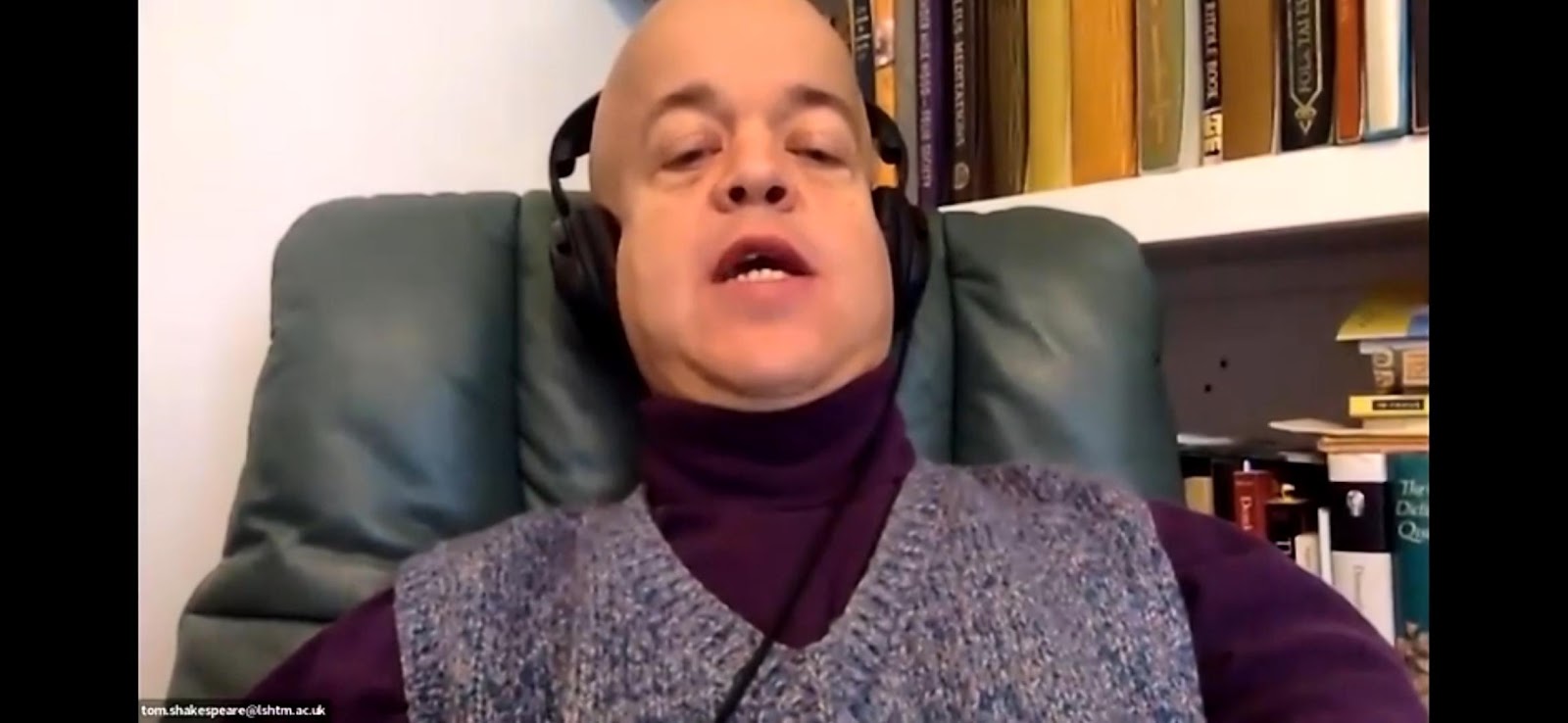
- Keynote address by Prof. Tom Shakespeare, Professor of Disability Research in the medical faculty at the London School of Hygiene and Tropical Medicine
- Plenary by Prof. Stephen Kuusisto, Professor at Syracuse University.
- Plenary by Prof. Sandhya Limaye, Centre for Disability Studies and Action , School of Social Work – Mumbai Campus, TISS
- Plenary by Prof. Fiona Kumari Campbell, Professor in School of Social Work at the University of Dundee
- Valedictory address by Prof. Anita Ghai Professor at School of Human Studies, Ambedkar University, Delhi
CALL FOR PAPERS
Indian Disability Studies Collective (IDSC)
In association with
Sri Guru Tegh Bahadur Khalsa College, Delhi University
&
Centre for Disability Research and Training, Kirori Mal College, Delhi University
IDSC INTERNATIONAL CONFERENCE 2021 (ONLINE)
CFP
Disability: Resistance, Disruption and Transgression
The word ‘resistance’ finds its roots in the Latin resistere: a combination of re which, as a morpheme, roughly symbolises a force back(ward) and sistere-to stand affirm. At the heart of the idea of resistance, then, there is titanic will towards the conservation of a self, individual and/or collective, against an encroaching force of aggressors. Over the ages, the phenomenon of resistance, driven by this essential will, has evolved multiple forms of manifestation as it has accrued frameworks for the individual and social desires for a renegotiation of the terrains of power. Thus, one witnesses, in the application of resistance, a broad range of behaviours and actions ranging from overt rebellion to covert acts of defiance. Not only have these diverse methodologies of resisting allowed different reactions to different forms of encroachments but have, rather comprehensively, also changed the way different socio-cultural entities and existences, across spatio-temporal coordinates, entangle with the needs of phenomenal resistance. Between the essential will and the different forms of manifestation, then, there is, implicit within the form of resistance, both a singularity and a multiplicity. No wonder then, as Hollander and Einhower (2004) show in their survey, different theoretical frameworks have defined resistance differently and yet, rather instinctually, maintaining the heart in the moment of the action of that will: ‘acting autonomously, in [one’s] own interests’ (Gregg 1993); ‘active efforts to oppose, fight and refuse to cooperate with or submit to…abusive behaviour and …control’ (Profitt 1996); ‘engaging in behaviours despite opposition’ (Carr 1998); or simply ‘questioning and objecting’ (Modigliani and Rochat, 1995). Within the modalities of this complex nature of resistance, finally, also lies the possibilities of its scale. It could, on the one hand, be acted at a grand ideological level by explicit collective mass movements or, on the other, find an actant within the individual’s “everyday” resistance that fits well with the understandings of less institutionalised but pervasive forms and modes.
Within such a theoretical framework, we propose to understand the concept of resistance in relation to disability. The questions, then, which come up immediately are: what happens when we discuss resistance with respect to the disabled identity in particular? When and where do disabled people tender resistance? Is it in everyday situations or in more systemic contexts, for example within families or against the education system? What compels them to such a push back? What are the many ways in which disabled people resist oppressive able-bodied norms, values and discriminatory practices, like the idea of a normal body? How do they reencounter and resist stigma, hegemony and social control? How do they issue a challenge to their personal realities, existing societal structures, cultural labels and proscriptions that serve to demean and devalue them? What are the various micro-level (individual/family), meso-level (institutional) and macro-level (social/ideological) ways that disabled people tender resistance? Is there a way to categorise the types of such resistance? What do we mean by passive or active resistance in the context of disability? How might we move from narrower conceptions of resistance in everyday lives in the context of disability to more broadly based ones? What are these conceptions? How might the complexity of the phenomenon or action or opposition be captured? How might we have a more nuanced understanding of how hegemony and resistance operate in the context of disability? This conference seeks answers to these and other related emergent questions with a focus on the complexities that resistance itself presents.
The Organising Committee welcomes research papers from a wide variety of interdisciplinary and theoretical perspectives, and submissions are organised into (but not necessarily confined to) the streams and sub-streams listed below:
- Conceptualising Disability Resistance
- Identity formation and Resistance
- Able bodied Hegemonies and Disablism
- Disability Resistance and other marginalised identities such as: caste, class, gender, sexuality, ethnicity, regionality, and so on.
- Everyday modes of Resistance
Prospective participants are requested to send a 300 words long abstract to idscconf2021@gmail.com with a 50 word bio-note.
Points to Remember
- Conference Dates: 29th November 2021-3rd December 2021
- Final Abstract (of 300 words) Submission Deadline: 30th September 2021
- Results of abstract review returned to authors: by 15th October 2021
- Registration Fee: INR 500 for paper readers and INR 300 for participants
- Final date of registration and fee payment: 10th November 2021
For any questions or queries please write to: idscconf2021@gmail.com
SCHEDULE
DAY 1: 29th November 2021
SESSION 1: 2:30PM-4:00 PM
Join Link: https://us02web.zoom.us/j/89564199379?pwd=Q0V1Z0J0NTFRdUt5eU1qSExDVmREdz09
Meeting ID: 895 6419 9379
Passcode: 110870
INAUGURAL SESSION
Welcome Address: Dr. Someshwar Sati, Chairperson, IDSC
Introductory Note 1: Prof. Jaswinder Singh, Principal, Khalsa College, Delhi University
Introductory Note 2: Prof. Vibha Chauhan, Principal, Kirori Mal College, Delhi University
Opening Remarks: Shilpa Das
Keynote Address: Tom Shakespeare
Chair: Nandini Ghosh
Vote of Thanks: Dr. Anurima Chanda, Joint Secretary, IDSC
SESSION 2: 4:30 PM-6:30 PM
TECHNICAL SESSION A: Disability and Experience (Chair: Sandeep Singh)
Join Link:
Meeting ID: 827 6100 1210
Passcode: 812115
- Resistance, Disruption, Transgression: Understanding the Possibilities of Sign Language through Madan Vasishta’s Memoir – Rimjhim Bhattacherjee
- “This Very Tenderness is Hurtful to Us”: Shunning Sympathy as a Means of Defying Deafness—the Case of Harriet Martineau – Anwesha Sengupta
- Living Life to the Fullest: Towards an Understanding of Disabled Children’s Childhood Studies – Noble A. Paliath
- Disability Sports and Arts-For Whom?: Impacts of the Tokyo 2020 Summer Paralympic Games on the Cultural Activities of Disabled Persons-Yayoi Mashimo
TECHNICAL SESSION B: Disability and Gender (Chair: Srinjoyee Dutta)
Join Link:
Meeting ID: 818 0579 5183
Passcode: 172642
- Women, Mental Disability and Resistance (Tentative)-Radhika Bali
- City, Gender and the Disablement of Space: A Study of Andhadi Gali (Blind Street) (1983) by Dhiruben Patel – Zarana Maheshwari
- The confluence of Disability and Queerness – Ambika Bhatnagar
- Subverting the Stereotype of Disabled Masculinity in Kumbalangi Nights – Nandana R
- Fostering Patient-Controlled Alternatives to Psychiatric Practices: The Rhetoric of Resistance, Liberation and Social Justice in Judi Chamberlin’s On Our Own- Swikriti Sanyal
DAY 2: 30th November 2021
SESSION 1: 2:30PM-4:30 PM
TECHNICAL SESSION A: Disability and Assertion (Chair: Nandini Ghosh)
Join Link:
Meeting ID: 827 6100 1210
Passcode: 812115
- “To my ears it is a language”: Enabling Resistance to ASD Oppression – Lorna Fitzsimmons
- From Rights to Resistance: Notes on Protests of the Blind in Post-2010 Tamil Nadu – Boopathi P
- Disability and Politics of Assistance: From Complicity to Resistance – Gunjan Kumari
- “#TheFinalStraw Meets #SuckItAbleism – Tracing Linguistic Pathways of Disability Activism in the Age of Ecology-Eva Spisiakova
TECHNICAL SESSION B: Disability and Discourse (Chair: Ritwick Bhattacharjee)
Join Link:
Meeting ID: 818 0579 5183
Passcode: 172642
- Law and Disability : Reading Resistance Through Court Judgements – Sanchita Sarkar
- From the physical-psycho-social constructivism to the spirituo-philosophical sublime: A study of Disability from an Indic knowledge perspective in the Post-humanistic/Transnational world – Ardra P Kuma and Dr. Rukmini S.
- Resisting Ableism in the Everyday: A Critical Discourse Perspective – Reshma Jose
- Mayuri’s disability as ‘manhoosiyat’: Problematizing the Classical in Nache Mayuri – Mansi Grover
SESSION 2: 5:00 PM-6:30 PM
Join Link: https://us02web.zoom.us/j/89564199379?pwd=Q0V1Z0J0NTFRdUt5eU1qSExDVmREdz09
Meeting ID: 895 6419 9379
Passcode: 110870
Plenary: Stephen Kuusisto (Chair: Sandeep Singh, Technical Assistance: Dr. Anurima Chanda)
Day 3: 1st December 2021
SESSION 1: 2:30PM-4:00 PM
Join Link: https://us02web.zoom.us/j/89564199379?pwd=Q0V1Z0J0NTFRdUt5eU1qSExDVmREdz09
Meeting ID: 895 6419 9379
Passcode: 110870
Plenary: Dr. Sandhya Limaye (Chair: Shilpa Das)
SESSION 2: 4:30 PM-6:30 PM
TECHNICAL SESSION A: Disability and Performance (Chair: Banibrata Mahanta)
Join Link:
Meeting ID: 827 6100 1210
Passcode: 812115
- Dancers with Disability: Choreographing New Movement Definitions in Indian Dance Forms-Suman Bhagchandani
- Conceptualising Resistance through Disability Performance Art – Jaya Sarkar
- Writing Disability and Disabled Writing: Gazing at Dattani’s Tara through a Glass Impaired – Dr. Asijit Datta
- Women and the Politics of Branding Disability-Mehar Fatima.
TECHNICAL SESSION B: Narrativizing Disability 1 (Chair: Anita Kamra Verma)
Join Link:
Meeting ID: 818 0579 5183
Passcode: 172642
- From Resistance to Reconciliation: Radical Intimacy in John Hull’s “Open Letter from a Blind Disciple to a Sighted Saviour” – Krishna Kumar S
- Disability and Accessibility in Neil Matheson’s Daddy Bent-Legs – Dr. Sudhaker Kalakota
- Storying Disability: Testimony and Narration in Graphic Medicine – Amrita Krishnan
- ‘Lunatics of the World’: A Study of Struggle and Resistance of a Person with Mental Disability in Gayathri Ramprasad’s Shadows In The Sun: Healing From Depression And Finding the Light Within (2014) – Radhika Sharma
Day 4: 2nd December 2021
SESSION 1: 2:30PM-4:00 PM
Join Link: https://us02web.zoom.us/j/89564199379?pwd=Q0V1Z0J0NTFRdUt5eU1qSExDVmREdz09
Meeting ID: 895 6419 9379
Passcode: 110870
Plenary: Dr. Fiona Kumari Campbell (Chair: Shilpaa Anand)
SESSION 2: 4:30 PM-6:30 PM
TECHNICAL SESSION A: Disability and Literary Narratives 1 (Chair: Karuna Rajeev)
Join Link:
Meeting ID: 827 6100 1210
Passcode: 812115
- Gendering Madness and Doubling Disability in Jane Eyre – Dr. Sunanda Sinha
- Dismantling the ‘Normative’: Jonathan Swift’s Gulliver’s Travels (1726) – Aishwarya Jha
- Advertising the Freak: Marginalisation and Transgression in Victorian Disability Narratives – Enrica Zaninotto
- Understanding Resistance in The Tin Drum – Shankara Reddy P G
TECHNICAL SESSION B: Disability and Literary Narratives 2 (Chair: Mukul Chaturvedi)
Join Link:
Meeting ID: 818 0579 5183
Passcode: 172642
- Dwarves, Derelicts and Outcastes in Bengali Fiction Arunabha Bose
- Invisible People and Disability : Identifying Resistance in Everyday Mothering Practices – Gurpreet Kaur Saini
- Acid Attack – A Study of Survivors’ Resistance through Recollections and Representations in Select Indian Narratives. – Ega Peter
- Caste Blindness and Dalit Vision: The Blind Tau in Sheoraj Singh Bechain’s My Childhood on My Shoulders – Deeba Zafir
TECHNICAL SESSION C: Disability and Literary Narratives 3 (Chair: Ranu Uniyal)
Join Link: https://us02web.zoom.us/j/89564199379?pwd=Q0V1Z0J0NTFRdUt5eU1qSExDVmREdz09
Meeting ID: 895 6419 9379
Passcode: 110870
- Contextualising Resistance: Seen and Unseen in No Straight Thing Was Ever Made by Urvashi Bahuguna- Aditi Krishna
- The “blind other” in select Malayalam Popular Verses -Sayoojya C. S.
- Interrogating Normality: Reading Resistance in Tagore’s “Drishtidaan” and “Subha” – Deepak Kumar Gupta
- Seeing Beyond Able Bodied Hegemonies: A Reading of ‘Three Blind Men Describe an Elephant – Brati Biswas
Day 5: 3rd December 2021
SESSION 1: 2:30PM-4:30 PM
TECHNICAL SESSION A: Narrativizing Disability 2 (Chair: Madhvi Zutshi)
Join Link:
Meeting ID: 818 0579 5183
Passcode: 172642
- Memoir, Malady and (Mis)Treatment: Counter-Diagnosis and (Feminist) Interrogation of Ableism in Girl,Interrupted – Kaustabh Kashyap
- Representation of differently abled characters in Twentieth century Hindi novel in English Translation from a postcolonial perspective – Akhilesh Kumar
- Reels and hashtags as resistance: Reading some social media Posts of people with Disability – Dr Richa
- Through Kristeva’s Eyes of ‘Liberty, Equality, Fraternity, and …Vulnerability’: An Analysis of Vulnerability, Singularity, and Power Equations in Bangalore Days – Rajdeep Vijayaraj and Prachi Goradia
TECHNICAL SESSION B: Disability and Education (Chair: Kalpana Brar)
Join Link:
Meeting ID: 827 6100 1210
Passcode: 812115
- Resisting the everyday disabling environment in India – Rinki Chokhani
- Of Transgression in a Classroom: Indigenous Education, Vocation, and Care for the Disabled in Late Colonial Bengal – Tirtha Pratim D
- Resisting institutional ableism at South African universities: student disability activism and self-advocacy skills – Desire Chiwandire
- Reconfiguring disablism in Manjula Padmanabhan’s The Island of Lost Girls– Himashree Swargiary
TECHNICAL SESSION C: Disability and Cinema (Chair: Shilpaa Anand)
Join Link: https://us02web.zoom.us/j/89564199379?pwd=Q0V1Z0J0NTFRdUt5eU1qSExDVmREdz09
Meeting ID: 895 6419 9379
Passcode: 110870
- Disability: An Insight Into The Inner World – Nikita Yadav
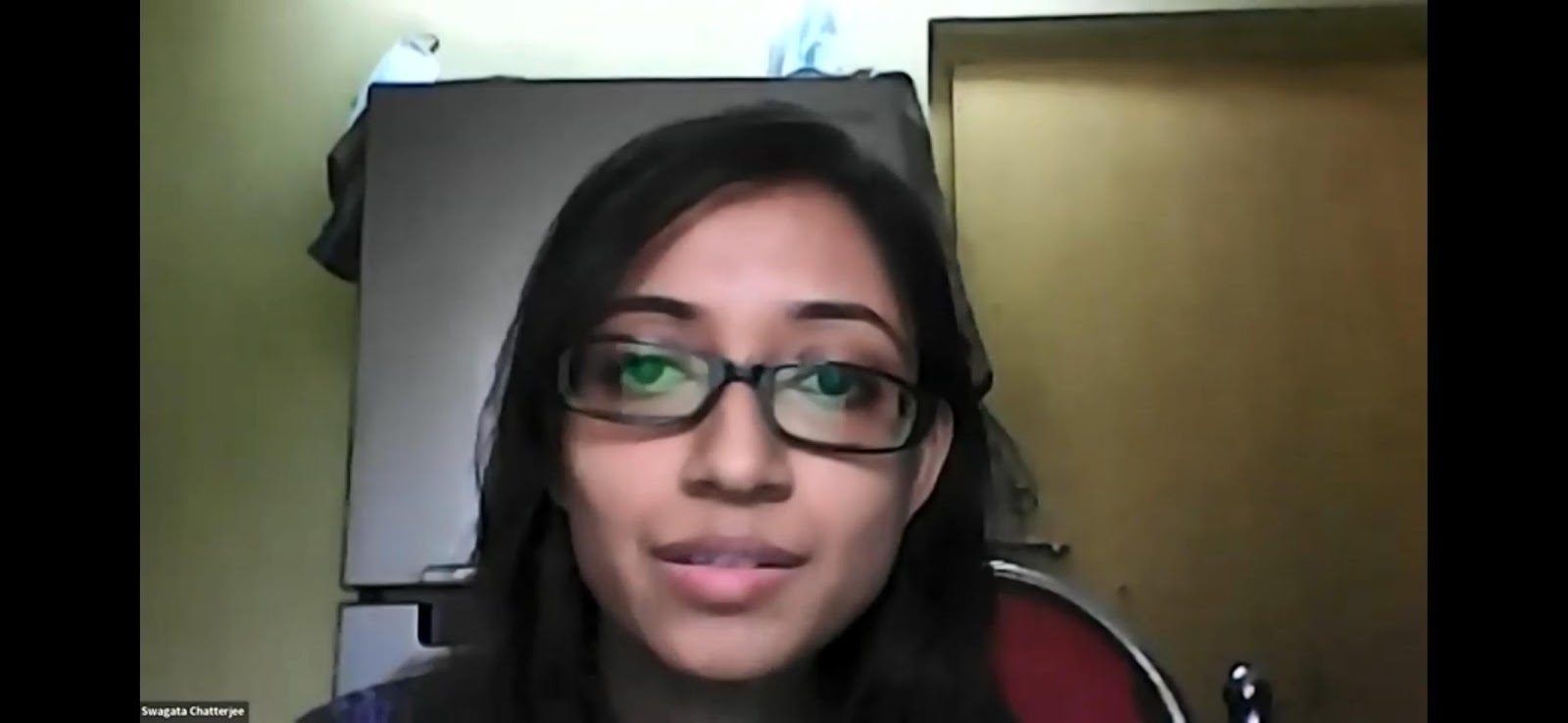
- Reading Margarita with a Straw: Resisting and Accepting the Disabled Self – Swagata Chatterjee
- Aesthetic Nervousness and the culture of representation in Animated Films – Surasree Deb Barman
- Truffaut’s Camera in The 400 Blows: disability and revolt of a child – Kalplata
SESSION 2: 5:00PM-6:30PM
Join Link: https://us02web.zoom.us/j/89564199379?pwd=Q0V1Z0J0NTFRdUt5eU1qSExDVmREdz09
Meeting ID: 895 6419 9379
Passcode: 110870
Valedictory Session: Anita Ghai (Chair: Hemachandran Karah)
Concluding Remarks: Karuna Rajeev
Vote of Thanks: Mukul Chaturvedi
SESSION REPORTS
DAY 1: 29th November 2021
SESSION 1: 2:30PM-4:00 PM
After a welcome by Prof Someshwar Sati, Chairperson IDSC and the two principals, Prof. Jaswinder Singh and Prof. Vibha Chauhan, the session was handed over to Prof. Nandini Ghosh. She welcomed the keynote speaker, Prof. Tom Shakespeare.
Professor Tom Shakespeare spoke on the larger issues of agency and resistance, both of which have somehow been bypassed by the medical model of disability, which highlighted the inability of bodies and minds, and the social model that talked on inability of society to accept persons with disabilities. Using his qualitative research findings from Zambia, Uganda and Kenya, Prof. Shakespeare elaborated the ways in which disabled people resist. As disability exists as interaction, agency and resistance have to focus on intrinsic and extrinsic factors. Across cultures, disabled people have always been regarded negatively and thus it is presumed that disabled people cannot have agency. Even strong disability advocates and activists have been sucked into such ideologies. In the contexts of 3rd world countries, there are colonial legacies, cultural beliefs about disability and capacity, multidimensional poverty, lack of access to rehabilitation, social and environmental barriers and poor access to education that influences the experience of disability for many persons with disabilities. Despite the relative success of persons with disabilities in terms of education, work and family and community life, family reactions are almost always negative, with a focus on the corrective. Education system is experienced negatively as there are several barriers from distance of school, transport barriers to neglect, mockery and ostracism. Yet persistence has yielded positive outcomes. Similarly in employment there is open discrimination in formal and informal sectors, evident in the fact that disabled people work more in DPOs, which itself is a sign of resistance and agency. Disabled people display agency and resistance, which stems from the determination and hard work to be independent. Their resilience can be attributed to their confidence and ability to sustain hope, which is necessary for positive adaptation within significant adversity. He pointed out that there is a parallel between persons with disabilities and non disabled people but this is never perceived as such and neither is individual agency ever interpreted as resistance. Framing resilience as the everyday magic of ordinary normative human resources in the minds and bodies within families, relationships and communities, Prof. Shakespeare recommended adversity inoculation which means protecting communities from negative attitudes to ensure persons with disabilities emerge stronger in their everyday lives and are able to make the most of any situation. While external resources will be needed to support disabled people in their process of development, internal resources of resilience built through positive reinforcement and challenging the negative assumptions associated with disability
SESSION 2: 4:30 PM-6:30 PM
TECHNICAL SESSION A: Disability and Experience (Chair: Sandeep Singh)
This session consisted of four engaging papers by four emerging scholars in the field of Disability studies:
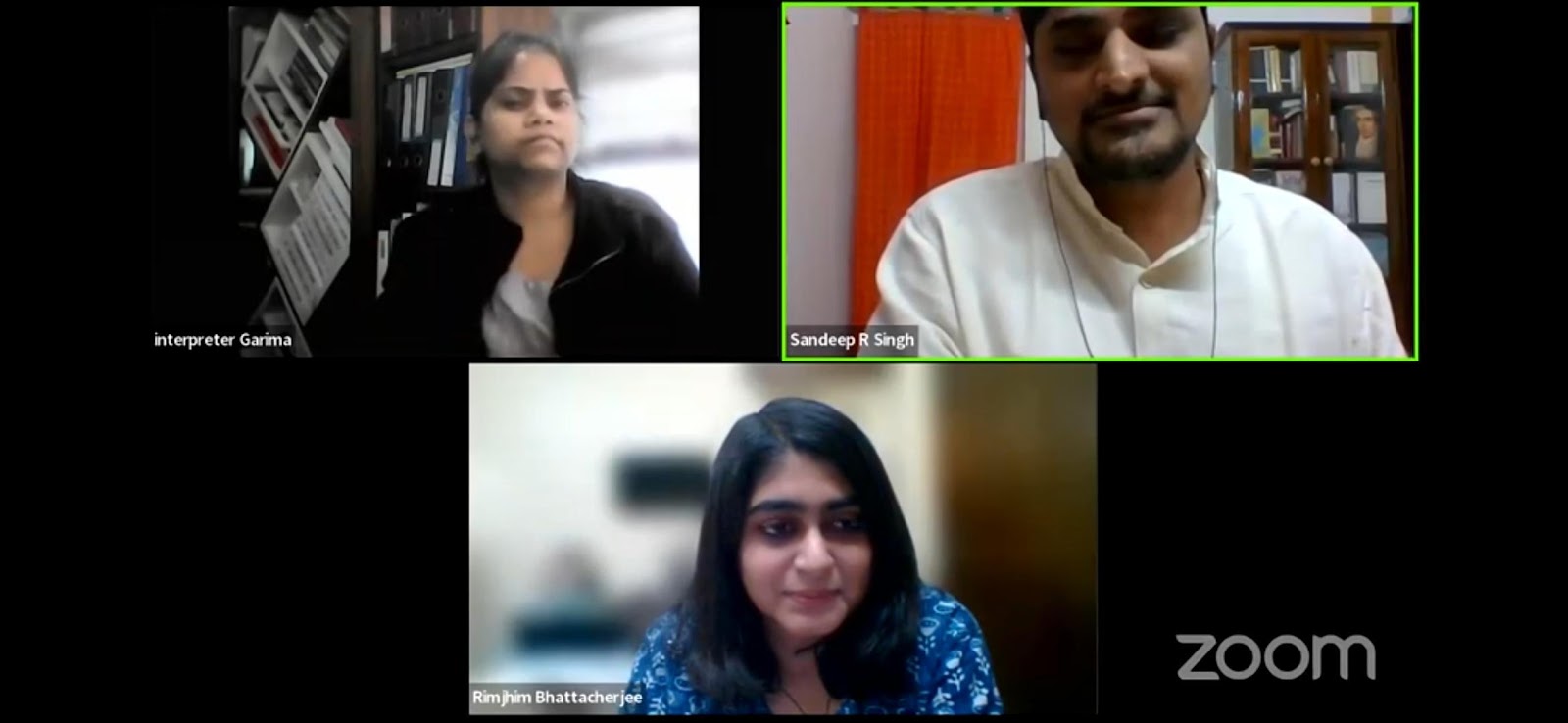
Rimjhim Bhattacherjee presented a paper titled Resistance, Disruption, Transgression: Understanding the Possibilities of Sign Language through Madan Vasishta’s Memoir. She begins her paper by talking about how His journey is a classic instance of shift from the normative medical perception of deafness as ‘hearing loss’ to that of ‘Deaf gain’, initiated by his induction into the Deaf community and the world of Sign Language. She draws from Goffman’s Stigma (1963) and Friedner’s Valuing Deaf worlds in urban India (2015), to analyse Vasishta’s representation of Indian sign language as a transgressive force that challenges and compels the reframing of normative ableist perceptions of deafness and helps readers transcend a medical perception of it to take what Deaf Studies calls a ‘Deaf turn.’
The second speaker, Anwesha Sengupta, Presented a paper titled “This Very Tenderness is Hurtful to Us”: Shunning Sympathy as a Means of Defying Deafness—the Case of Harriet Martineau. Her paper discusses how Harriet Martineau, relegated to her sick room, used writing as a tool of resistance against the social exclusion that her hearing loss imposed on her. Using Thomas G. Couser’s framework of life writing she analyses how Harriet uses writing as a method to not only evade the sympathy that she and her likes were subjected to, but also as a method of inspiring others “belonging to her fraternity”.
The third speaker Noble A. Paliath spoke on “Living Life to the Fullest: Towards an Understanding of Disabled Children’s Childhood Studies” which centred disabled children and talked of how they should be included in society. In her paper she attempts to challenge the negative practices and stereotypes that persist in the lives of disabled children and in doing so aims to celebrate their lives and to focus on the hopes and aspirations of disabled children, young people, their families and allies.
The fourth speaker, Yayoi Mashimo from Japan, presented a paper titled “Disability Sports and Arts-For Whom?: Impacts of the Tokyo 2020 Summer Paralympic Games on the Cultural Activities of Disabled Persons”. Yayoi explores the positive as well as the troubling impacts of the Tokyo 2020 Summer Paralympics held in august 2021 due to covid 19. She argues that on the one hand the Olympic Games under COVID-19 highlighted certain controversies, on the other the Paralympic Games helped cultivate a greater awareness and understanding of disability sports, disability art, and cultural opportunities for the disabled among the general public. However, there remain various unresolved issues identified by disability communities in this context including unsustainable support system for disabled athletes, media coverage that incorporates inspiration porn, enforcement of meritocracy that leads to neoliberalism, and the fragility of programs to support the creative activities of disabled people.
Towards the end of the session Each of the presenters were asked a few questions by the participants to which they gave satisfactory responses.
TECHNICAL SESSION B: Disability and Gender (Chair: Srinjoyee Dutta)
The session on ‘Disability and Gender’, held on 29 November 2021 as part of the IDSC International Conference 2021, comprised a panel of four speakers with Ms Srinjoyee Dutta in the capacity of chair.
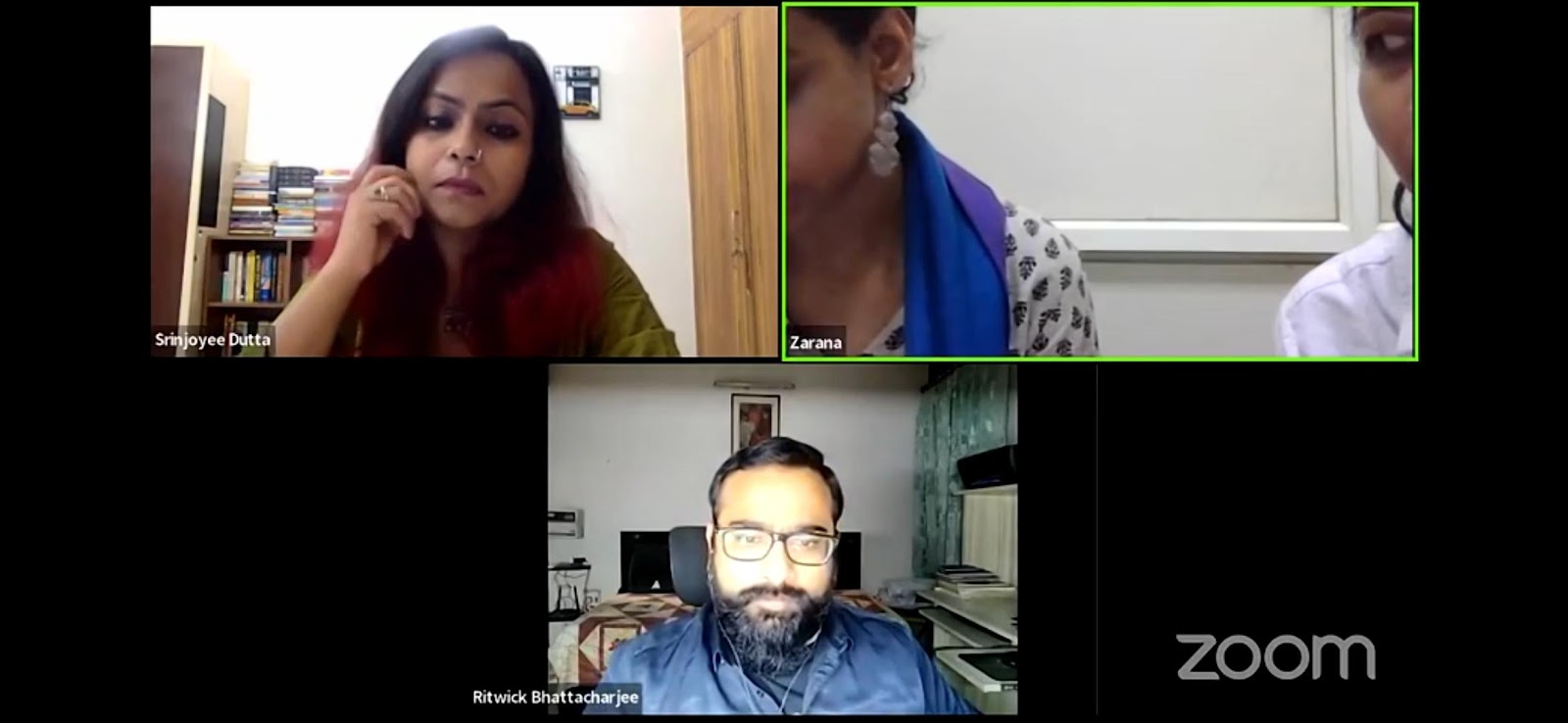
The first presentation was on ‘City, Gender and the Disablement of Space: A Study of Andhadi Gali by Dhiruben Patel’ by Ms Zarana Maheshwari who analysed the gendered disablement of space and body in the novel. The second speaker, Ms Radhika Bali, spoke about the possibilities of redefining the idea of resistance from the perspective of mental and psychosocial disability in her paper titled ‘Women, Mental disability and Resistance’. The third presentation, titled ‘Subverting the Stereotype of Disabled Masculinity in Kumbalangi Nights’, by Ms Nandana R, explored the notion of traditional masculinity and the idea of ‘wholeness’ in opposition to the disabled body as represented in the movie. The final presentation, namely, ‘Fostering Patient-Controlled Alternatives to Psychiatric Practices: The Rhetoric of Resistance, Liberation and Social Justice in Judi Chamberlin’s On Our Own’ by Ms Swikriti Sanyal used the text to analyse possible strategies of alternative care for people with mental disability. The session ended with an interactive discussion between the presenters, the chair, as well as the audience.
DAY 2: 30th November 2021
SESSION 1: 2:30PM-4:30 PM
TECHNICAL SESSION A: Disability and Assertion (Chair: Nandini Ghosh)
The session had 2 papers
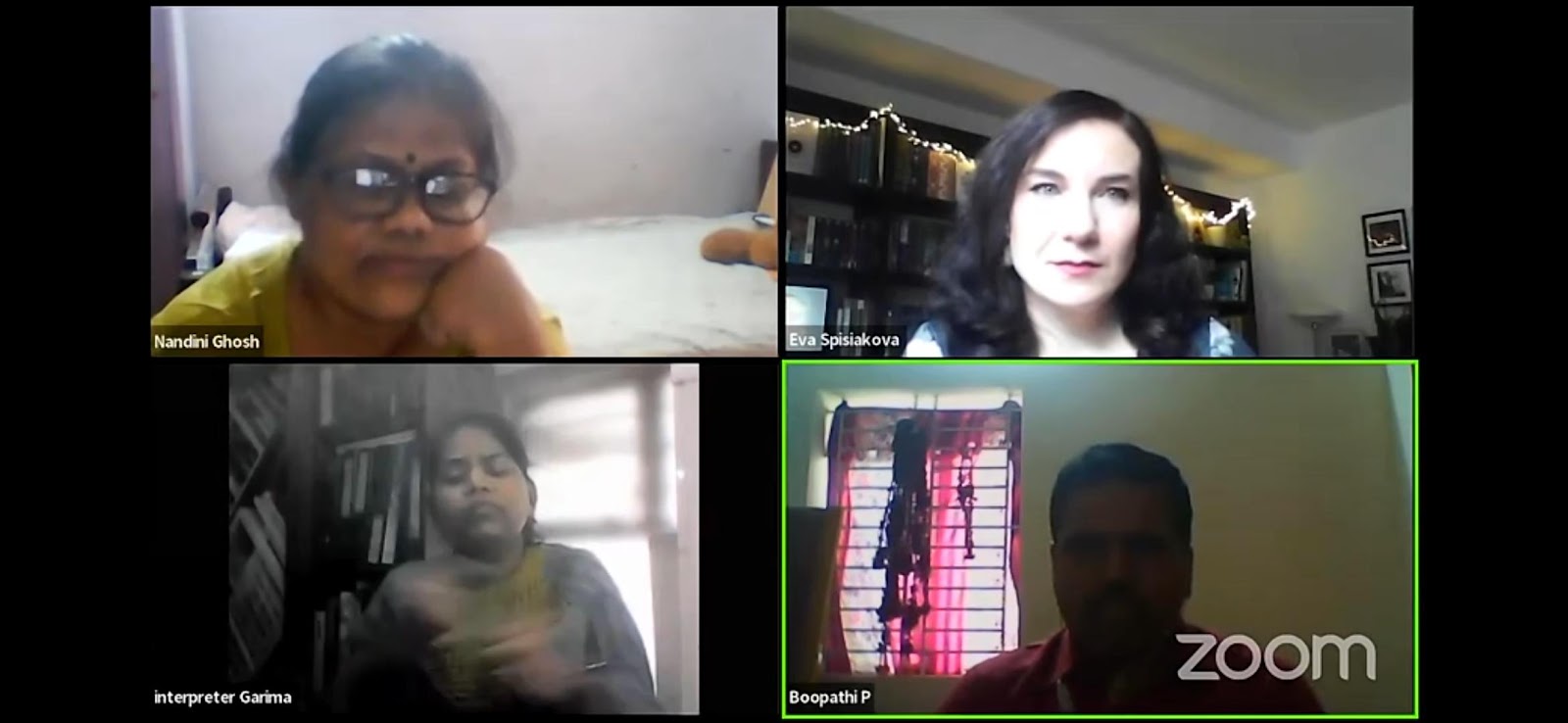
In his paper titled From Rights to Resistance: Notes on Protests of the Blind in Post-2010 Tamil Nadu, Boopathi P discussed about the different strategies used by the blind activists in Tamil Nadu to fight for their demands like scholarship, readers to read out books, employment opportunities and others. The College Students and Graduate Association of the Blind (CSGAB) has been staging numerous struggles against the state government for implementing various rights of the blind in Tamil Nadu. The CSGAB has concentrated mostly on fighting against the state government to implement reservation in education and employment for the blind and for their other rights. Yet the state has responded in diverse ways, seemingly allowing their demands but later circumventing these by using other measures. Boopathi attempted to link ways in which newer strategies have been used by blind activists in Tamil Nadu including the use of social media to organize protests and highlight their issues.
In her paper titled #TheFinalStraw Meets #SuckItAbleism, Eva Spišiaková stressed the different ways in which supports required by disabled people are often represented as environmental hazards, thereby further redefining the negative views of disability. Through a content analysis of journal articles on health issues, she clarified the ways in which such research and publications often portrayed these disability supports, like plastic straws or inhalers, etc are linked to adverse climate change outcomes. She reflected on media including newspapers which often portrayed capitalist propaganda by presenting disabled people as evil. She also pointed to the fact that translation was a political act with social contexts determining what gets translated, what words are used, who translates, and how the works trickle down into our vocabulary. The link between language, mindsets and narratives was stressed.
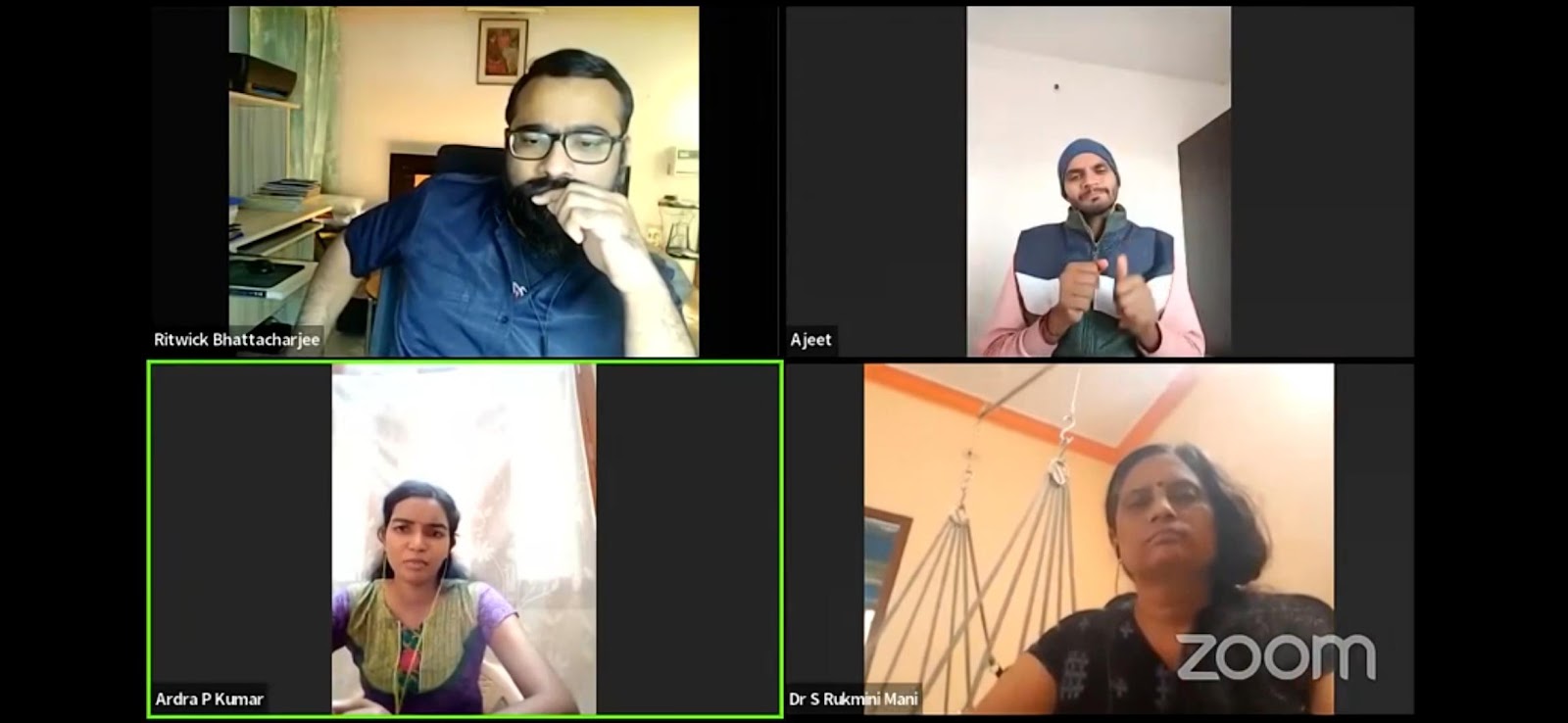
TECHNICAL SESSION B: Disability and Discourse (Chair: Ritwick Bhattacharjee)
This session had four papers
Ardra P Kumar and Rukmini S’ paper “From the physical-psycho-social constructivism to the spirituo-philosophical sublime: A study of Disability from an Indic knowledge perspective in the Post-humanistic/Transnational world” was the first one. Highlighting on the nuances of the East-West perceptions of disability, the paper primarily put forth the scriptural evidences to strengthen the sublime element of the Indian spirituo-philosophical perspective of disability. Secondarily, it meticulously examined and analysed the Indic knowledge texts to substantiate its argument. Finally, the paper also looked at the recent news concerning the disabled category of people and tries to map them within the context of critical posthumanism so as to know how disability is perceived in the transnational world, irrespective of varied notions.
Mansi Grover, in her paper “Mayuri’s disability as ‘manhoosiyat’: Problematizing the Classical in Nache Mayuri” looked at the aesthetics of disability stage performance as even disabled performers are asked to by-pass their disability on stage to look complete.
Reshma Jose’s third paper, “Resisting Ableism in the Everyday: A Critical Discourse Perspective” looked at resistance through four modes. Firstly, it studied writings in the first person by persons with disability as a mode of assertion and resistance within the community, where predominant epistemes are challenged and new, postmodern perspectives into disability are birthed. Secondly, it explored the assertion, articulation and expression of subjecthood in the everyday, particular and personal spheres of life as a mode of resistance. Thirdly, it shed light on pleasure as a mode of resistance; pleasure is a domain which has been systematically denied to persons with disabilities, particularly women, so narratives of desire may be read as polemical and dissident. And, finally, it explored the technique of masquerading disability as a mode of resistance, which is a concept that has also been theoretically associated with queer drag art performances.
The final paper by Sanchita Sarkar titled “Law and Disability : Reading Resistance Through Court Judgements” argued that laws and norms are two distinct but linked and overlapping mechanisms of the social order that function alongside each other to constitute the disabled subject. This was posited as a counter to Foucault’s assertion that only norms, in their disciplinary and regulatory capacity, are constitutive of the subject. It allowed the disabled subject to find a social space within legal systems as well.
The session concluded with some inciting discussions and questions to the readers from the audience.
SESSION 2: 5:00 PM-6:30 PM
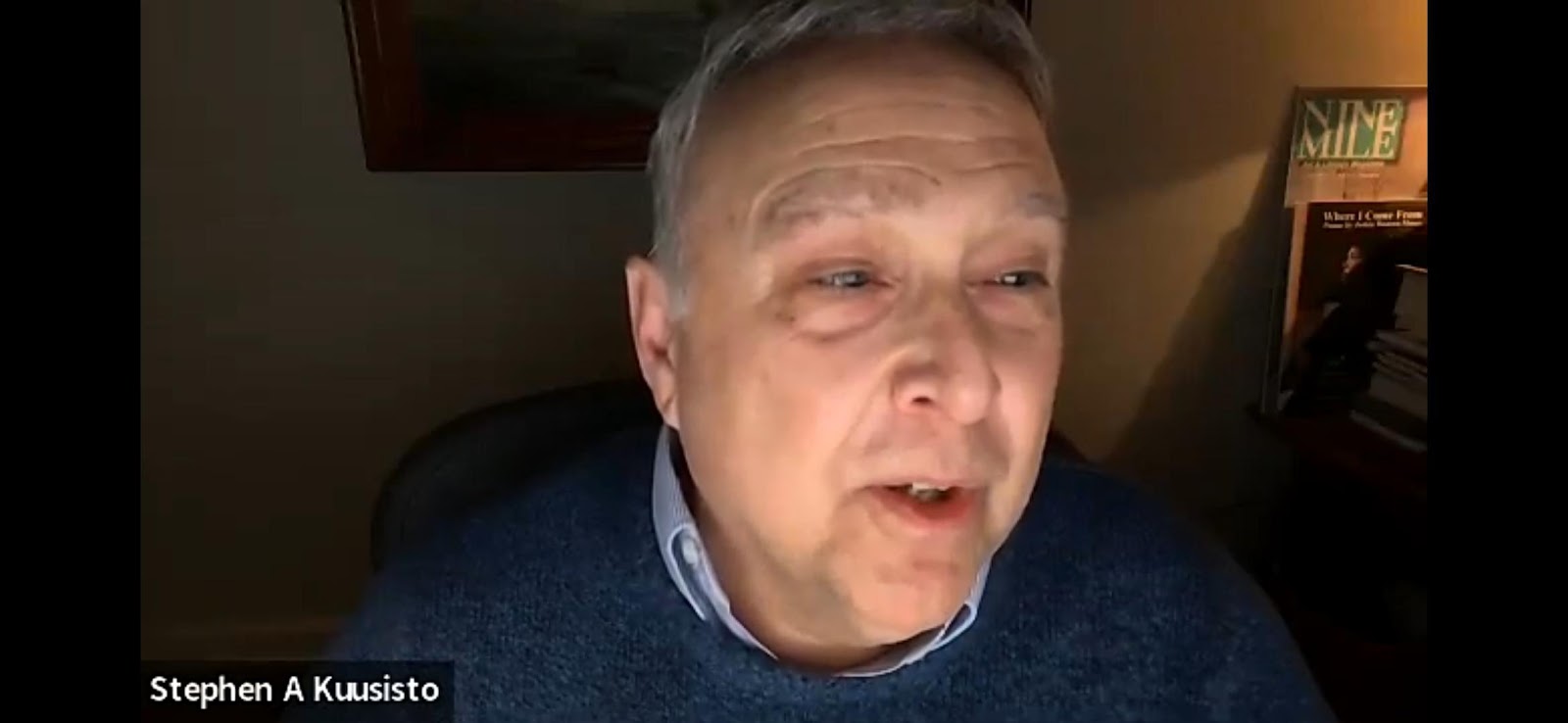
This was a Plenary session by Prof. Stephen Kuusisto and chaired by Sandeep Singh.
Professor Kuusisto began by talking about blind travel as a performance both within normative subventions of assistance and outside cultural denotations of helplessness. He goes on to assert that blind travel, taken as performance, is proleptic, both anticipating and answering implicit objections to the concept of blind independence in the very process of navigation. Speaking of the three caskets in The Merchant of Venice, Kuusisto first likens disability rhetoric to the third, leaden casket – seemingly the least important one. Glorifying the lead casket (or even doing poetry, as he points out) is like doubling the unlucky card. But there is more to the lead casket, as he goes on to show. Quoting Arthur Schopenhauer – “mental aptitude… (lends) events the significance they possess when he describes them ; to a man of genius they were interesting adventures; but to the dull perceptions of an ordinary individual they would have been stale, everyday occurrences.” Blind travel, with its myriad strangeness’s and lyric discoveries, is a similarly subjective process, contingent on the interiority – the “mental aptitude” as Schopenhauer would have it – of the blind traveller. Getting lost is a refrain Kuusisto returns to over and over in the lecture, describing it as an imaginative moment, a blind art project where time slows down and prolepsis holds supreme, enabling one to build alternate architectures and construct cities in one’s imagination. Kuusisto juxtaposes this artfully with concrete realism – as he sits in Hyde Park in London constructing citiscapes of the imagination, “The old woman passing by saw my hands at work./She thought I was a lost blind man, a simpleton,/Said, “Poor Dearie!” and gave me a quid.”(“Letters to Borges from London”. Letters to Borges, Copper Canyon 2014). The offensiveness, conventional stereotyping , and simultaneously the sheer hilarity of the moment isn’t lost on Kuusisto, by any means. With blind experiences, he says, there is no framing of the eye, only a sequence of astonishments.
Day 3: 1st December 2021
SESSION 1: 2:30PM-4:00 PM
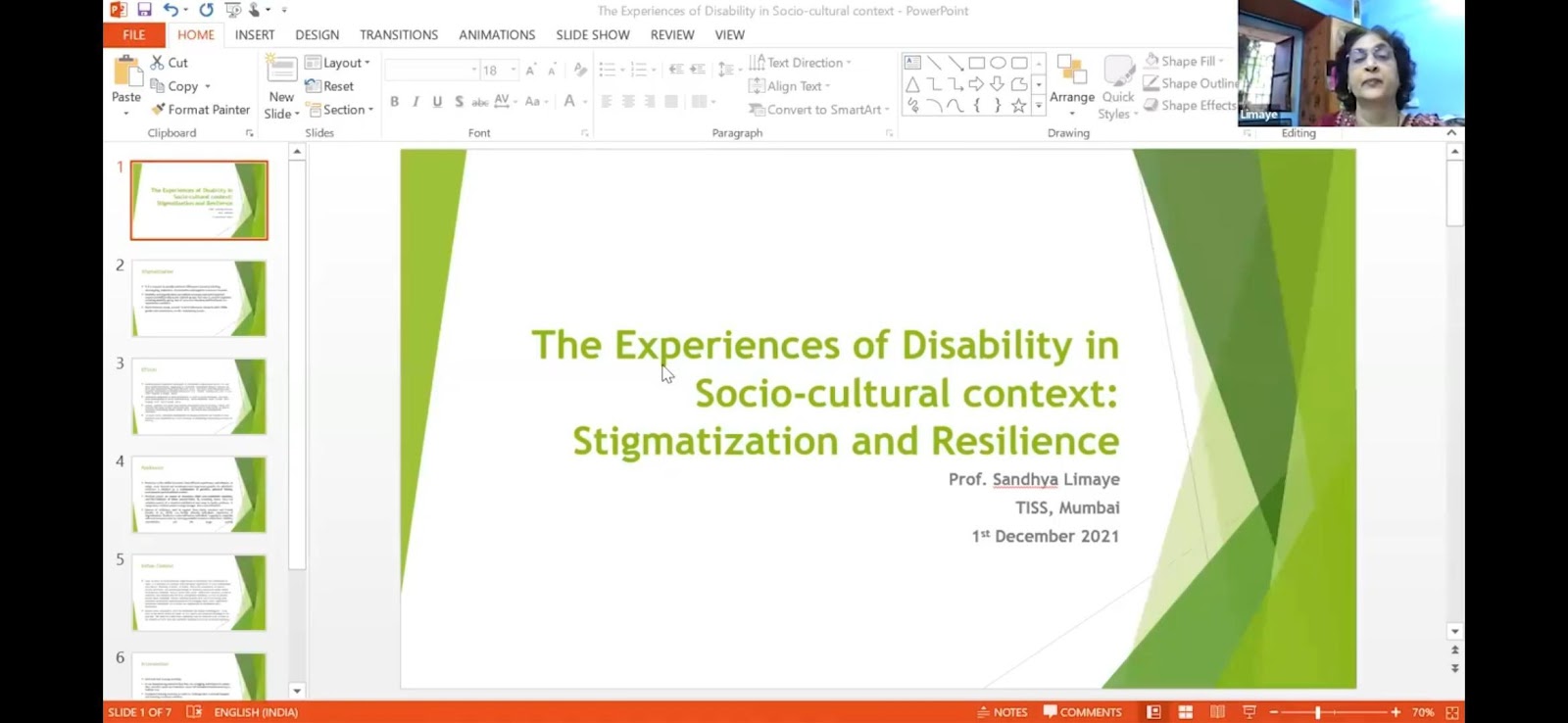
This was a Plenary session by Prof. Sandhya Limaye and chaired by Shilpa Das. In her talk, Prof. Limaye, through a few personal experiences, spoke about the lived life experiences of a deaf person as she navigates through the world and trying to figure out the disabling environment built by the social spaces surrounding her.
SESSION 2: 4:30 PM-6:30 PM
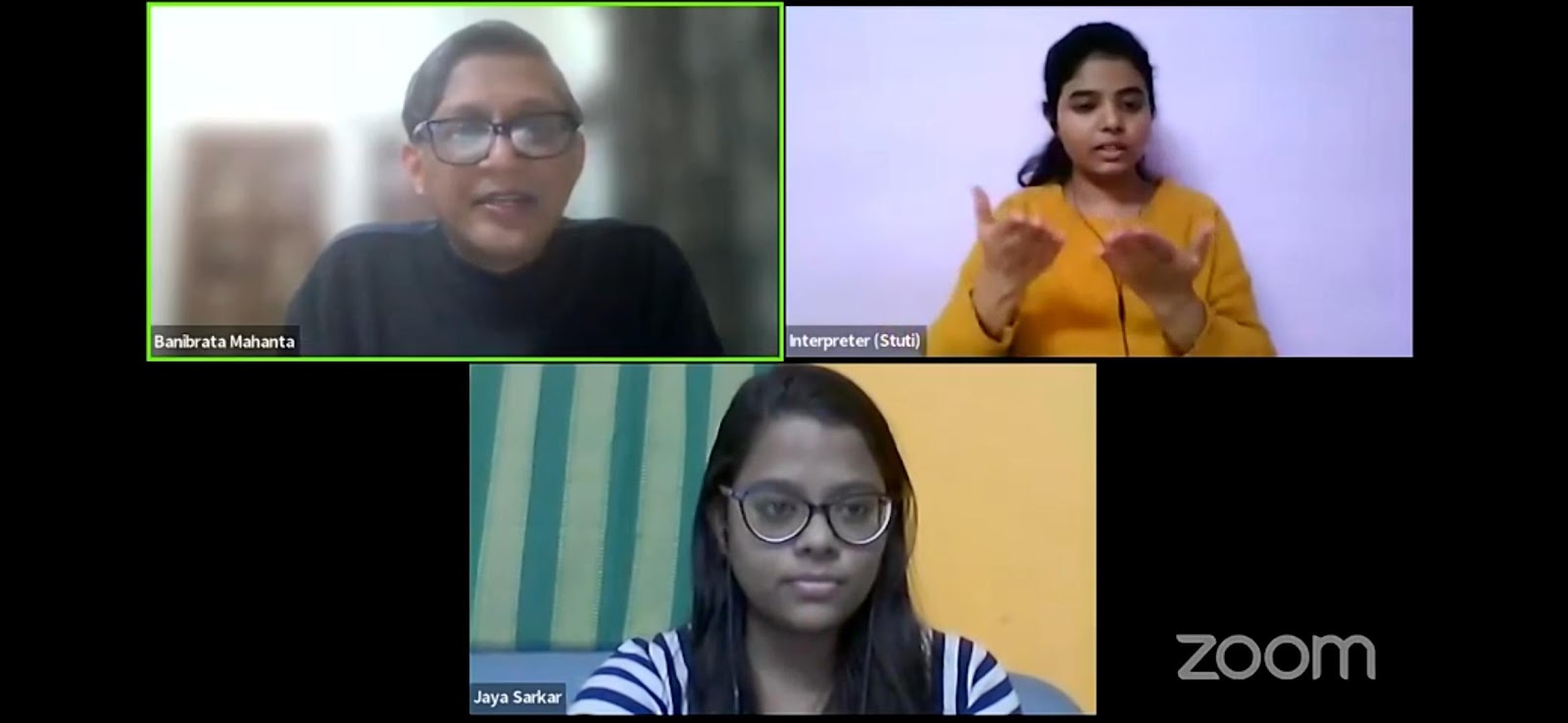
TECHNICAL SESSION A: Disability and Performance (Chair: Banibrata Mahanta)
The Technical Session A on 1 December 2021 commenced at 4.30 pm. There were four presenters in this session titled “Disability and Performance”: “Dancers with Disability: Choreographing New Movement Definitions in Indian Dance Forms” by Suman Bhagchandani, PhD scholar in the Department of English, Jamia Milia Islamia University, “Conceptualising Resistance through Disability Performance Art” by Jaya Sarkar, PhD scholar in Cultural Studies at BITS Pilani (Hyderabad Campus), “Writing Disability and Disabled Writing: Gazing at Dattani’s Tara through a Glass Impaired” by Dr. Asijit Datta, Assistant Professor of English at The Heritage College, under Calcutta University, and “Women and the Politics of Branding Disability” by Mehar Fatima.
Given the current scenario, where disability representation in performing arts is minimal, it was heartening to see three papers which explored three different aspects of resistance in performance. The first paper critiqued ableist constructions of ‘classical’ dance forms in ancient India and their perpetration in modern times, and explored how recent incursions into this largely ableist domain have challenged existing equations. The second paper moved beyond the first in exploring how traditional distinctions between life and art are interrogated, and how performance art has emerged as a potent medium to problematize not just conventional ways of meaning making but also ableist constructions of society. The third paper was an attempt to explore disability in theatre from the perspective of the author’s creation of character vis-à-vis the director’s effort at re-presenting the character on stage. All three presenters explored the two ways in which we can approach disability and performance: disability in performance and disability as social performance. They brought out important issues like the need to put forward a genealogy of the intersectional area between disability and performance, to critique existing ways of representing disability in performance, to review existing ways of representing both normativity and disability as well as to talk about enabling performers and audience through the use of accessible practices.
The fourth paper in the session was an overview of disability terms and concepts from a feminist perspective.
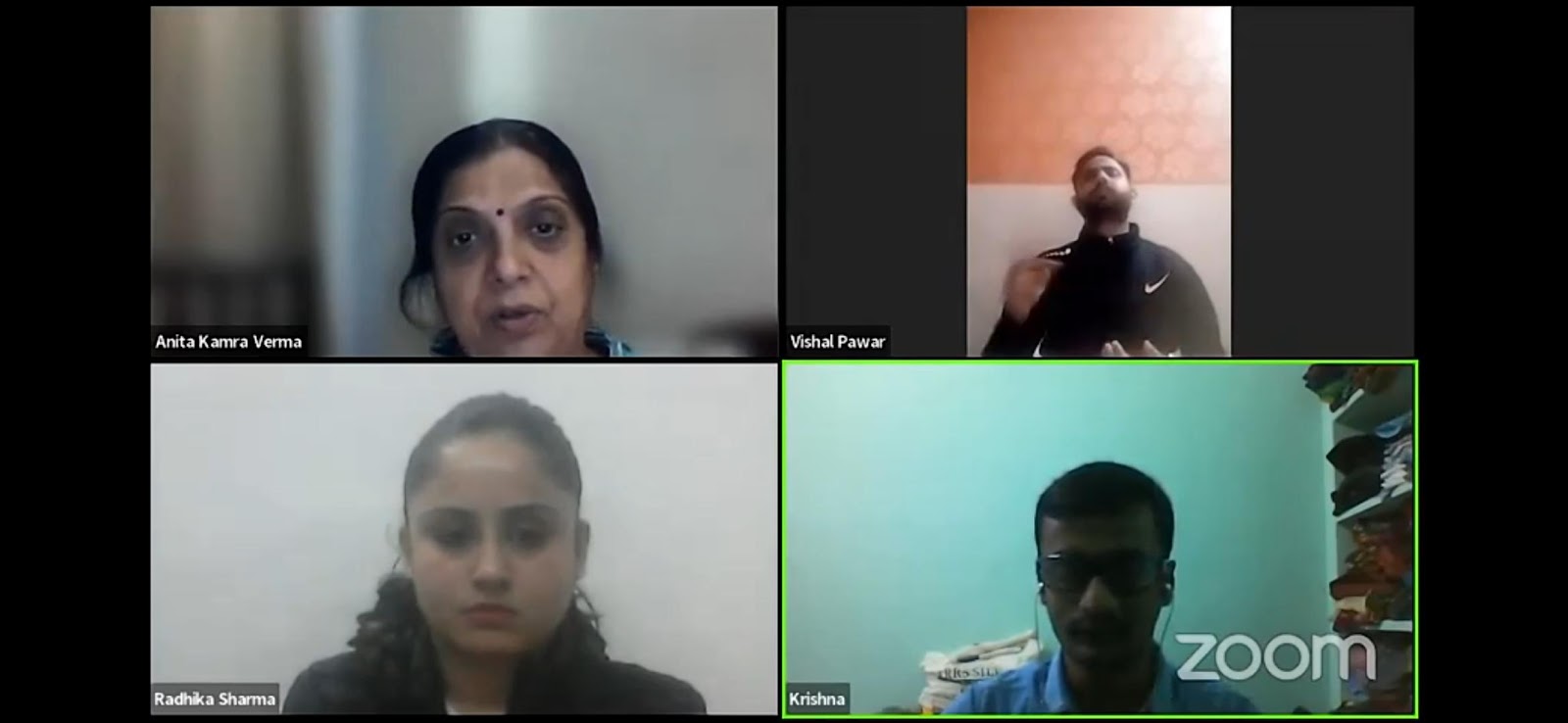
TECHNICAL SESSION B: Narrativizing Disability 1 (Chair: Anita Kamra Verma)
Report for Day 3: 1st Dec 2021 of IDCS coonference
Technical Session B: Narrativizing Disability
The Technical Session B: Narrativizing Disability 1 on Day 3 of the IDSC International Conference 2021 on “Disability: Resistance, Disruption and Transgression” was chaired by Prof. Anita Kamra Verma. A separate link was provided for each session. The link to join the meeting was:
The session was attended by 30 participants. The first speaker was Krishna Kumar S, a doctoral candidate from the Department of English Literature, and Foreign Languages University, Hyderabad, India. He gave an insightful view of the epistolary practice of blind writers from the early modern period onwards. His topic for deliberation was “From Resistance to Reconciliation: Radical Intimacy in John Hull’s “Open Letter from a Blind Disciple to a Sighted Saviour”. There were interesting questions from the participants that were very well explained by Krishna Kumar.
The Second speaker, Dr. Sudhaker Kalakota who had to speak on “Disability and Accessibility in Neil Matheson’s Daddy Bent-Legs” was unable to join. The third speaker, Amrita Krishnan
regretted and her topic on “Storying Disability: Testimony and Narration in Graphic Medicine”
Ms Radhika Sharma, a Senior Research Fellow in the Department of Humanities and Social Sciences at Indian Institute of Technology Roorkee, India spoke on “Lunatics of the World’: A Study of Struggle and Resistance of a Person with Mental Disability in Gayathri Ramprasad’s Shadows In The Sun: Healing From Depression And Finding the Light Within (2014). She spoke on the Visible disability as well as the invisible disability that becomes more severe. Interesting questions were asked by the participants. Ms Radhika was able to answer them with a lot of conviction.
The session concluded with a vote of thanks to the speakers and the participants by the chair.
Day 4: 2nd December 2021
SESSION 1: 2:30PM-4:00 PM
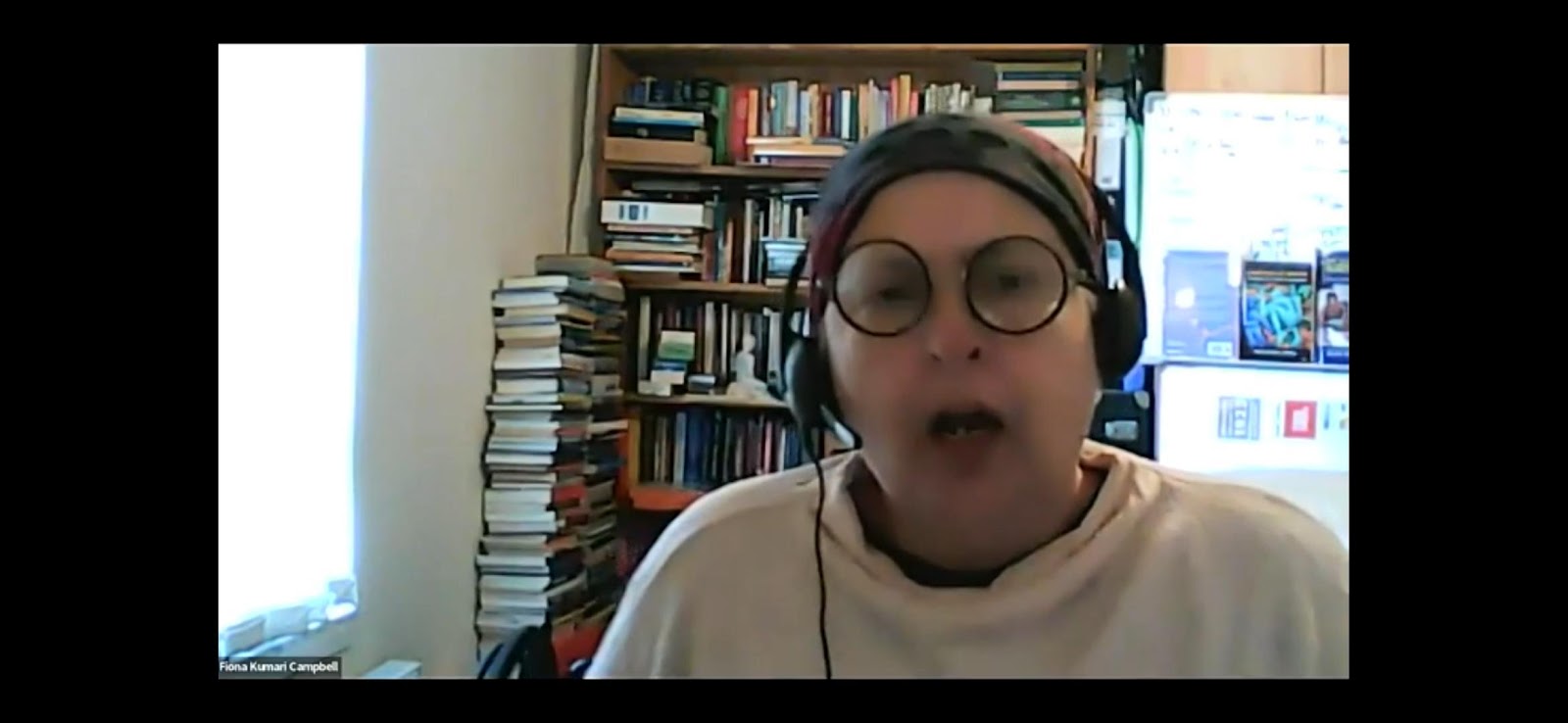
This was a plenary session by Prof. Fiona Kumari Campbell and chaired by Shilpaa Anand. In it, Prof. Campbell spoke about the necessity to find new and more nuanced definitions of ableism that would enable society to not only comprehend disablism better but also find out other arenas where ability markers take over personal material existences.
SESSION 2: 4:30 PM-6:30 PM
TECHNICAL SESSION A: Disability and Literary Narratives 1 (Chair: Karuna Rajeev)
This session had three papers
Aishwarya Jha’s paper “Dismantling the ‘Normative’: Jonathan Swift’s Gulliver’s Travels (1726)” closely examined Gulliver’s Travels from the lens of Disability Studies to academically establish that ‘normal’ is a hegemonic construct.
Shankara Reddy’s paper “Understanding Resistance in The Tin Drum” looked at the novel The Tin Drum by Gunter Grass as it captures the marginalized, cornered, and subjugated position of disabled people, and the strong resistance shown by the disabled character, Oskar.
Sunanda Shah’s paper “Gendering Madness and Doubling Disability in Jane Eyre” problematized madness and, in doing so, argued a cultural narrative of representation that is affected by an impaired mind of Bertha. It interrogated how the narrative systematically maps her resistance to forge a doubling within which she is objectified, influenced, muted, bounded and characteristically disabled.
The session ended with a lively discussion with the chair.
TECHNICAL SESSION B: Disability and Literary Narratives 2 (Chair: Mukul Chaturvedi)
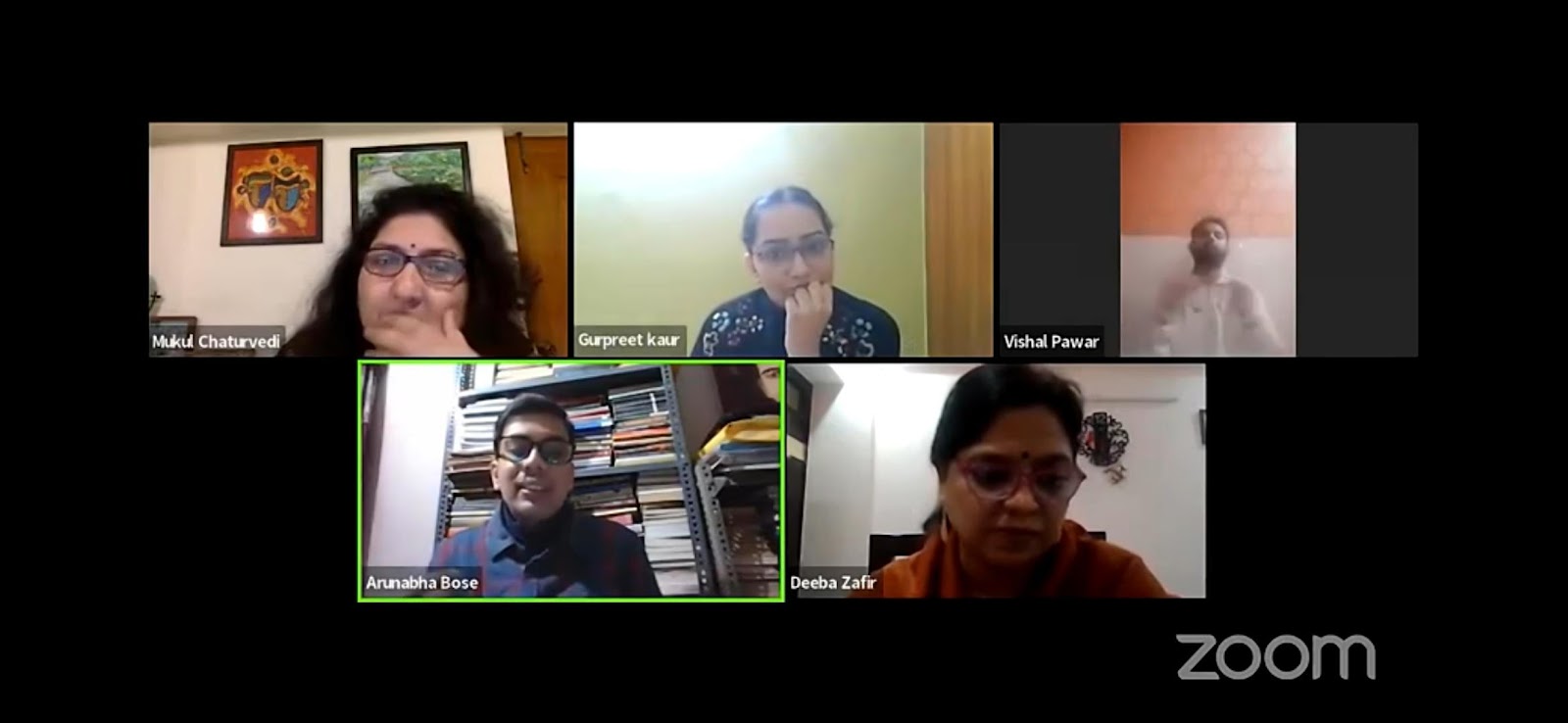
With its focus on literary representations of disability, this session explored the intersections of disability with caste, gender, and sexuality. The papers argued that literary narratives deconstruct dominant tropes of disability through their innovative modes of resistance. Deeba Zafir’s paper ‘Caste Blindness and Dalit Vision’ examined Sheoraj Singh Bechain’s autobiography as an oppositional discourse, contesting dominant Hindi literary tradition which has invisibalized caste, rendering the Dalit and the disabled figure as non-human. Arunabha Bose’s paper “Dwarves, Derelicts and Outcastes in Bengali fiction” explored the question of disabled sexuality in Manik Bandhopadhaya ‘Pragoitihishik’, addressing the cultural correlation between disability and femininity and an assertion of disabled male sexuality. Focusing on the gendered dimension of care giving, Gurpreet Kaur Saini’s paper addressed the systemic violence embedded in the normalization of the sacrificial figure of the caregiver, and the possibilities resistance in a mother-child relationship. An interesting session, the papers probed literary representations of disability as a site for disruption and transgression.
TECHNICAL SESSION C: Disability and Literary Narratives 3 (Chair: Ranu Uniyal)
This session had four papers
Aditi Krishna’s paper looked at No Straight Thing Was Ever Made (2021) by Urvashi Bahuguna to read the underpinnings of normativity of the able bodied with an invisible illness and seek to understand the varied sites of resistance in the oppressive framework of what is considered normal and what isn’t.
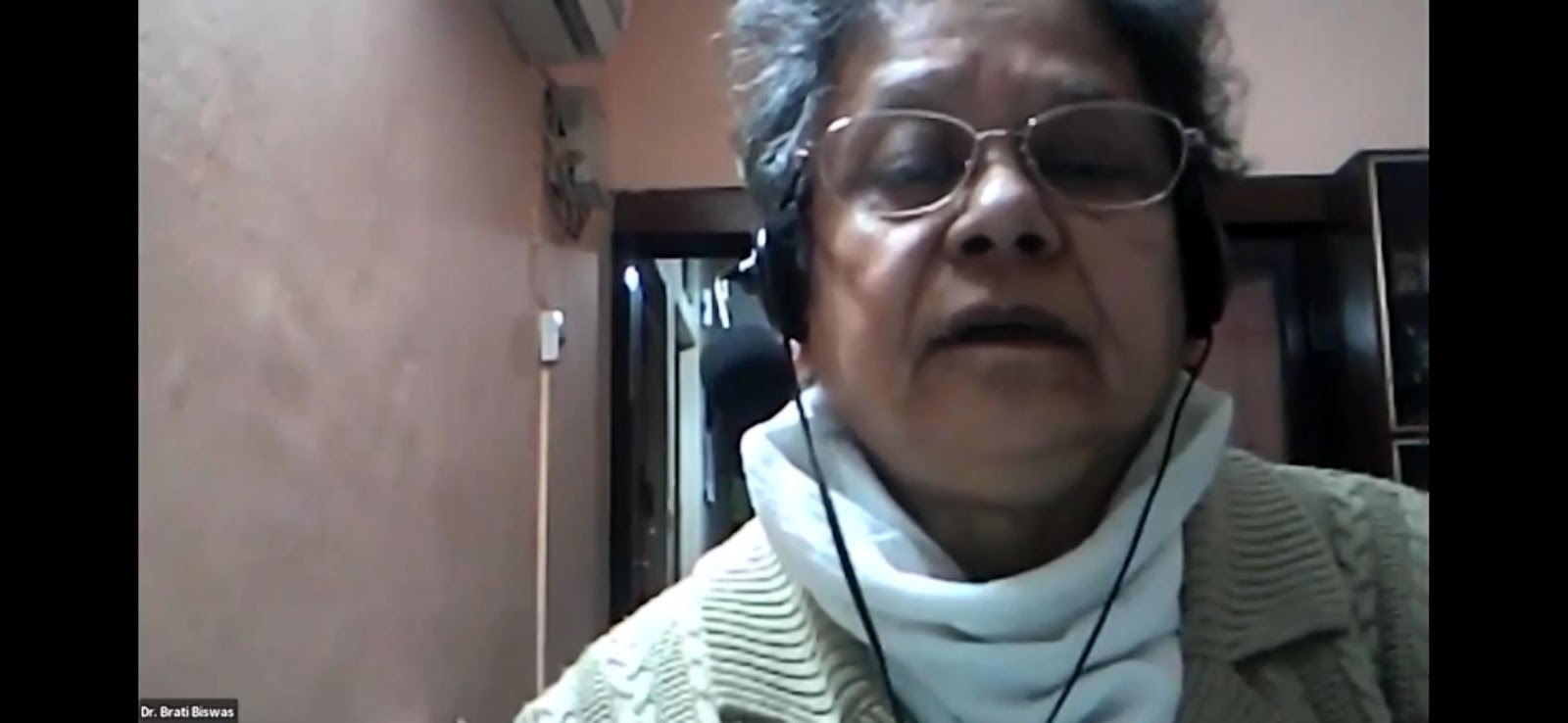
Brati Biswas, in her paper, “Seeing Beyond Able Bodied Hegemonies: A Reading of ‘Three Blind Men Describe an Elephant’” explored the ideas of normalcy, stigma, independence, agency and authorial intent in relation to the story through E Santosh Kumar’s Story “Three Blind Men Describe an Elephant”.
Deepak Kumar Gupta, through his paper “Interrogating Normality: Reading Resistance in Tagore’s “Drishtidaan” and “Subha”” looked at two short stories by Rabindranath Tagore, “Drishtidaan” and “Subha”, to examine Tagore’s alternative mode of representing women with disabilities.
Sayoojya C.S. in “The “Blind Other” In Select Malayalam Popular Verses” attempted to trace how the visually challenged community of Kerala experiences a sense of “othering” while confronted with a few selected popular Malayalam verses which are part of their own culture. It explored the ways in which the lines written even by some well-known and acclaimed poets of Malayalam offers support systems for the popular sayings which are risen out of ignorance that affirms the superior attitude of the abled people which treat the visually challenged community as the “other” of the mainstream society, or that which attribute the state of blindness with negative stereotypes. The analysis also included how the figures of speech involved in the verses deal with the concept of blindness into its fold. Along with taking into consideration the different genres of verses like film song, album song, and poem, the paper also shall attempt to explore the gender spaces in the selected popular verses.
Day 5: 3rd December 2021
SESSION 1: 2:30PM-4:30 PM
TECHNICAL SESSION A: Narrativizing Disability 2 (Chair: Madhvi Zutshi)
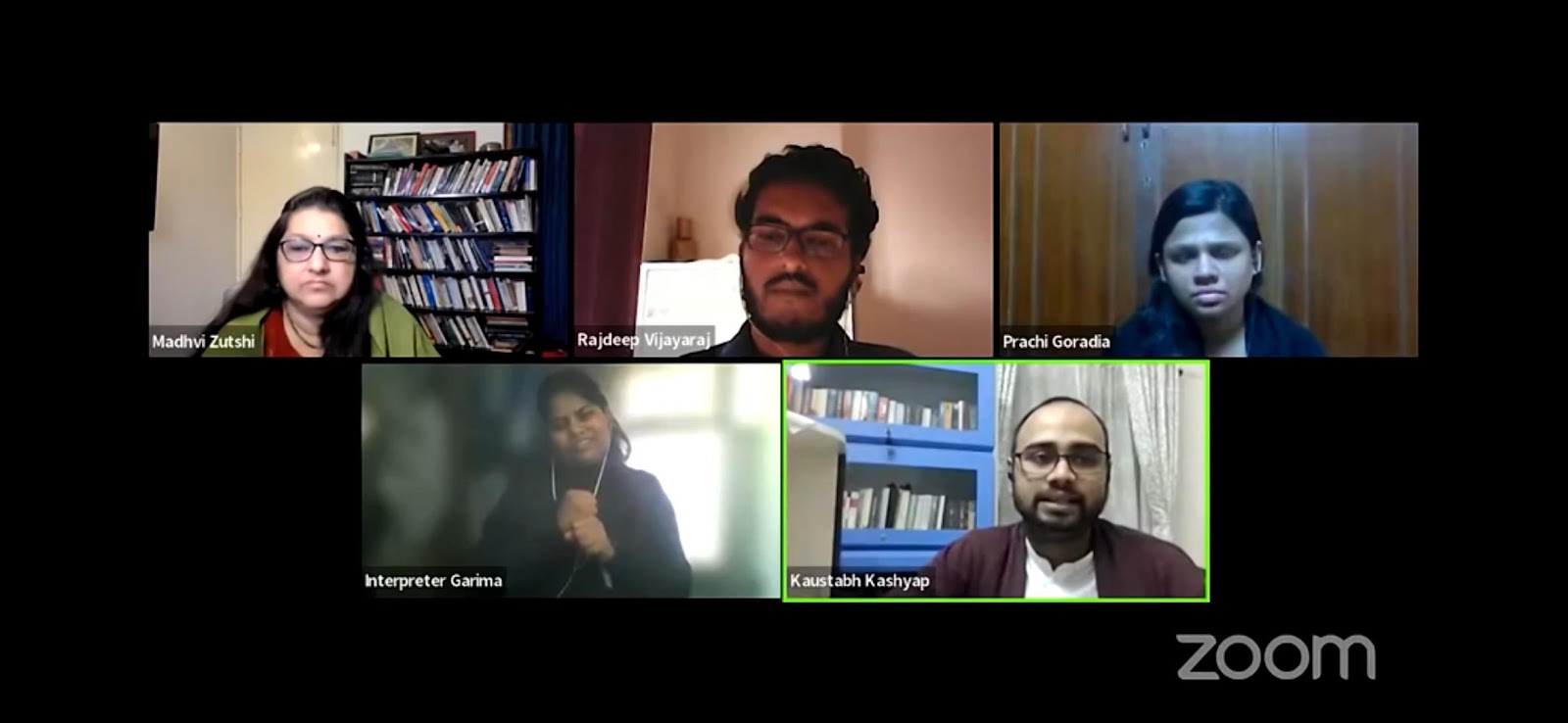
The technical session held online on 3rd December 2.30-4.40 was titled “Narrativizing Disability 2” with three presentations. Kaustabh Kashyap, a PhD scholar from Assam presented a comprehensive and thought-provoking paper on an American 1960s disability memoir Girl,Interrupted. The second paper on 20th century Hindi novels by Dr. Akhilesh Kumar focused on Gandhian ideals in disabled characters, and the third was an interesting analysis of interaction between the abled and disabled through a juxtaposition of Kristeva’s notion of ‘vulnerability’ and a reading of the Malayalam film Bangalore Days by Rajdeep Vijayaraj and Prachi Goradia. All the three papers brought new enquiries on the idea of representing disability in writing and film. The discussion at the end was particularly engaged and meaningful.
TECHNICAL SESSION B: Disability and Education (Chair: Kalpana Brar)
This session had four papers
Tirtha Pratim Deb in “Of Transgression in a Classroom: Indigenous Education, Vocation, and Care for the Disabled in Late Colonial Bengal” spoke towards an indigenous interest in colonial processes of assimilation through education and care to theorize resistance in its negotiation with certain modernizing principles which sought to engage with a complex and varied population of disabled subjects.
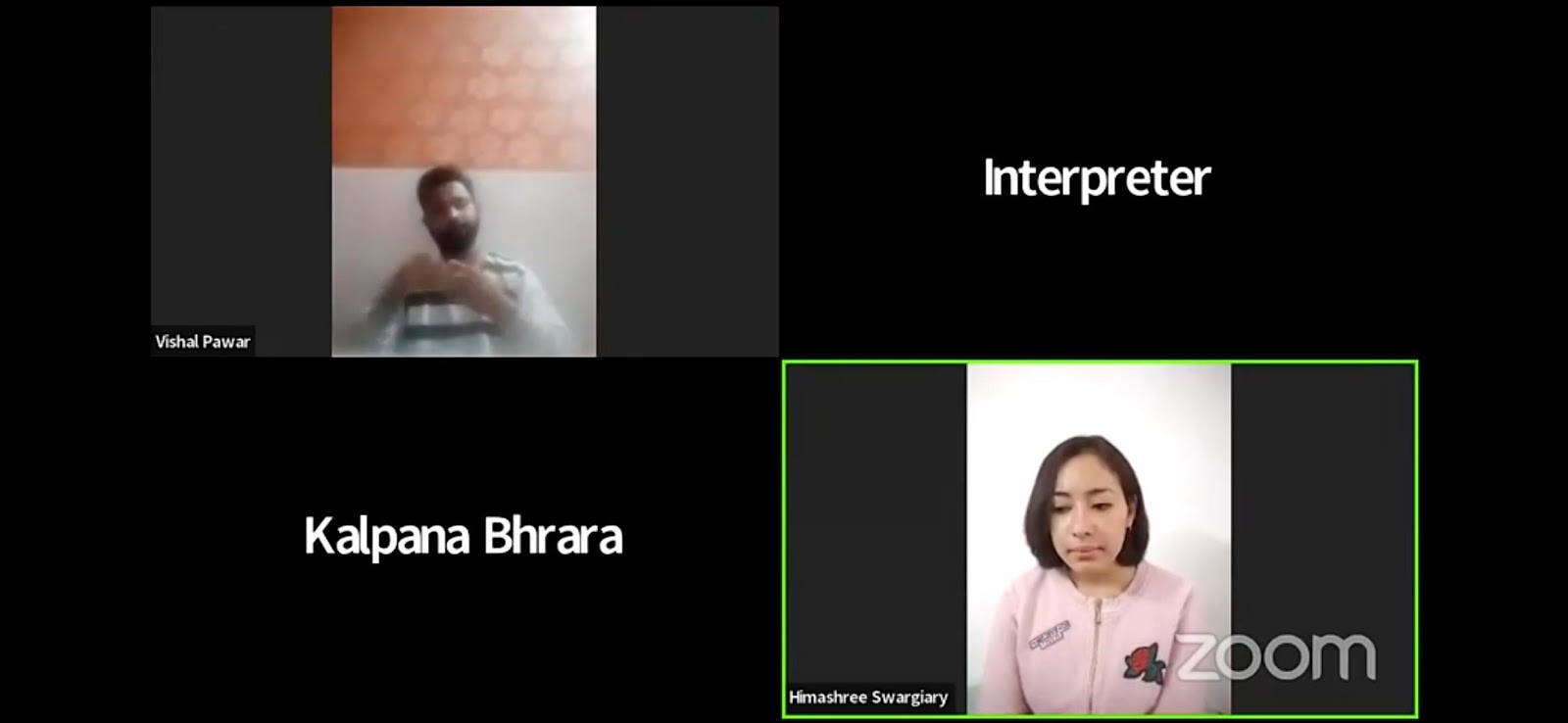
Himashree Swargiary in “Reconfiguring disablism in Manjula Padmanabhan’s The Island of Lost Girls” read Manjula Padmanabha’s novel The Island of Lost Girls as a story of resistance against the stigmatised disabled body—working as a statement against the stereotypes, prejudices and misconceptions of the ableist views on the disabled lot.
Enrica Zaninotto in her paper “Advertising The Freak: Marginalisation And Transgression In Victorian Disability Narratives” aimed at analysing, from an ethical point of view, the transgressive depiction of physical impairments in nineteenth century English Literature.
Desire Chiwandire’s paper “Resisting institutional ableism at South African universities: student disability activism and self-advocacy skills” recorded the results of a review that the author conducted of disability inclusion literature in order to gain an in-depth understanding of whether students with disabilities at South African higher education institutions have self-advocacy skills.
TECHNICAL SESSION C: Disability and Cinema (Chair: Shilpaa Anand)
In her paper “Truffaut’s Camera in The 400 Blows: disability and revolt of a child”, Kalplata studied the “disabled” world of Antoine as seen through the adult gaze in Truffaut’s The 400 Blows; also, it read closely Truffaut’s camera angles that capture the rebellion of a child who wants to break free from the adult gaze and attempts to build a “room” of his own. Thus, in this paper, the rebellion of a “disabled” childhood was seen through the eyes of Truffaut’s camera.
Nikita Yadav’s paper “Disability: An Insight Into The Inner World” explored the experiences of mothering a disabled child.
Saurasree Deb Burman in “Aesthetic Nervousness and the culture of representation in Animated Films” examined some animated characters with disabilities and show how the audience’s perspective is influenced by the tension of the predominant protocols governing those animated films—a short-circuit generated by the representation of disability.
Swagata Chatterjee’s paper “Reading Margarita with a Straw: Resisting and Accepting the Disabled Self” studied disability and sexuality by focussing on the sexuality of a female disabled body through the 2015 cinema Margarita with a Straw directed by Shonali Bose, which deals with a Punjabi girl called Laila Kapoor; who is a patient of cerebral palsy and is bound to a wheelchair.
SESSION 2: 5:00PM-6:30PM
The conference ended with a valedictory address by Prof. Anita Ghai, who spoke about the necessity of individual resistance against a society which enforces normalcy and ableism and pointed out the necessity of conferences such as these towards the same. After Prof. Ghai’s address, Dr. Karuna Rajeev, Member IDSC, presented her final report of the conference. The five day conference ended with a note of gratitude to all parties involved, delivered by Dr. Mukul Chaturvedi, secretary IDSC.
Link to the Playlist of sessions by Centre for Disability Research and Training: https://youtube.com/playlist?list=PLBIc54INmMszrWxN07sY6JOQAR7mq0IAT
Link to the Playlist of sessions by SGTB Khalsa College: https://youtube.com/playlist?list=PLU526KVNQ-VWQ4xs9iMnUykZ0zvby49-E
PHOTOGRAPHS