A REPORT ON
Inclusive Pedagogy: Engaging Students With Disabilities
A one week online interdisciplinary faculty development program
17 – 21 January, 2022
Organised under the auspices of Pandit Madan Mohan Malviya National Mission on Teachers and Teaching Program, Ministry of Education, Government of India,
Supported by Dhun Pestonji Parakh Discretionary Trust.
presented by
The Centre for Disability Research and Training (CDRT)
Kirori Mal College, University of Delhi


Xavier’s Resource Centre for the Visually Challenged (XRCVC)
St. Xavier’s College, Autonomous, Mumbai
in collaboration with

Faculty Development Centre (FDC)
Mizoram University, Aizawl
About
A 5-day online interdisciplinary Faculty Development Programme (FDP) was organized under the auspices of the Pandit Madan Mohan Malviya National Mission on Teachers and Teaching Program, Ministry of Education, Government of India. Faculty members from colleges and universities across the country were invited to register and participate in this program.
The program was open to any higher education faculty who is keen on making their classrooms inclusive. As part of their deliverables, participants were expected to have 100% attendance across all 5 days, and were expected to complete activity assignments during the course duration – the assignments involved a mix of presentations, MCQ quizzes, self-reflection reports, and other research work.
The FDP aimed at equipping its participants with the necessary understanding and mindset that will help them become drivers of inclusive education in their respective institutes and their classrooms of educators employed in various higher education institutions in India. The objectives of this session were to:
- Develop an understanding of disability types.
- Gain an understanding of working with the educational needs of students with disabilities in inclusive classrooms.
- Learn about the intervention framework and strategies for inclusive higher education.
The program was conducted over a zoom conference call from 10:00 a.m. to 5:00 p.m. on all days from the 17th to 21st January 2022.
All lectures were conducted by XRCVC’s internal faculty, as well as distinguished external subject matter experts, with immense on-field experience. The learning methodology involved a blend of lectures, presentations, quizzes, case study discussions, and problem-solving.
The programme schedule was as given in the table below:
| 10 a.m. – 12 p.m. | 12 p.m. – 1 p.m. | 1 – 2 p.m. | 2 p.m. – 4 p.m. | 4 p.m. – 5 p.m. | |
| Day 1 | Sensitization session on Lives of Persons with Physical Disabilities(Mr. Krishna Warrier, Consultant – Project Implementation, XRCVC) | Understanding Inclusive Education & Disability Models(Ms. Neha Trivedi, Project Consultant, XRCVC) | Lunch | Understanding lives of students with blindness: (Including Assistive Technologies) | General Principles of Inclusive Education(Ms. Neha Trivedi, Project Consultant, XRCVC) |
| 10 a.m. – 11 a.m. | 11 a.m. – 1 p.m. | 1 – 2 p.m. | 2 – 4 p.m. | 4 – 5 PM | |
| Day 2 | Understanding Specific Learning Disabilities (SLD) | Assistive Technologies for SLD & Teaching strategies for students with SLD | Lunch | Activity for checking understanding of day | Teaching strategies for inclusive education Part 1 |
| 10 a.m. – 1 p.m. | 1 – 2 p.m. | 2 p.m. – 5 p.m. | |||
| Day 3 | Understanding Hearing Impairment & Higher Education Interventions (Including Assistive Technologies)Ms. Akila Surendran, Senior Engineer (Assistive Technology) at CATI, NISH | Lunch | Understanding Autism Spectrum Disorder & Higher Education InterventionsDr. Sushama Nagarkar, | ||
| 10 a.m. – 11 a.m. | 11 a.m. – 1 p.m. | 1 – 2 p.m. | 2 p.m. – 3 p.m. | 3 p.m. – 5 p.m. | |
| Day 4 | Inclusive Higher Education – Organizational interventions(Ms. Neha Trivedi, Project Consultant, XRCVC) | Setting up Support services at Higher Education(Ms. Neha Trivedi, Project Consultant, XRCVC) | Lunch | Setting up Delivery Mechanism for implementation of Inclusive Education(Ms. Neha Trivedi, Project Consultant, XRCVC) | Activity on Building mechanism for institute(Ms. Neha Trivedi, Project Consultant, XRCVC) |
| 10 a.m. – 12 p.m. | 12 p.m. – 1 p.m. | 1 – 2 p.m. | 2 p.m. – 4 p.m. | 4 p.m. – 5 p.m. | |
| Day 5 | Teaching strategies for inclusive education- Part 2(Ms. Neha Trivedi, Project Consultant, XRCVC) | Group work and presentation on creating classroom lessons | Lunch | Group work and presentation on creating classroom lessons | Concluding Remarks & Feedback Session(Dr. Sam Taraporevala, Director, XRCVC) |
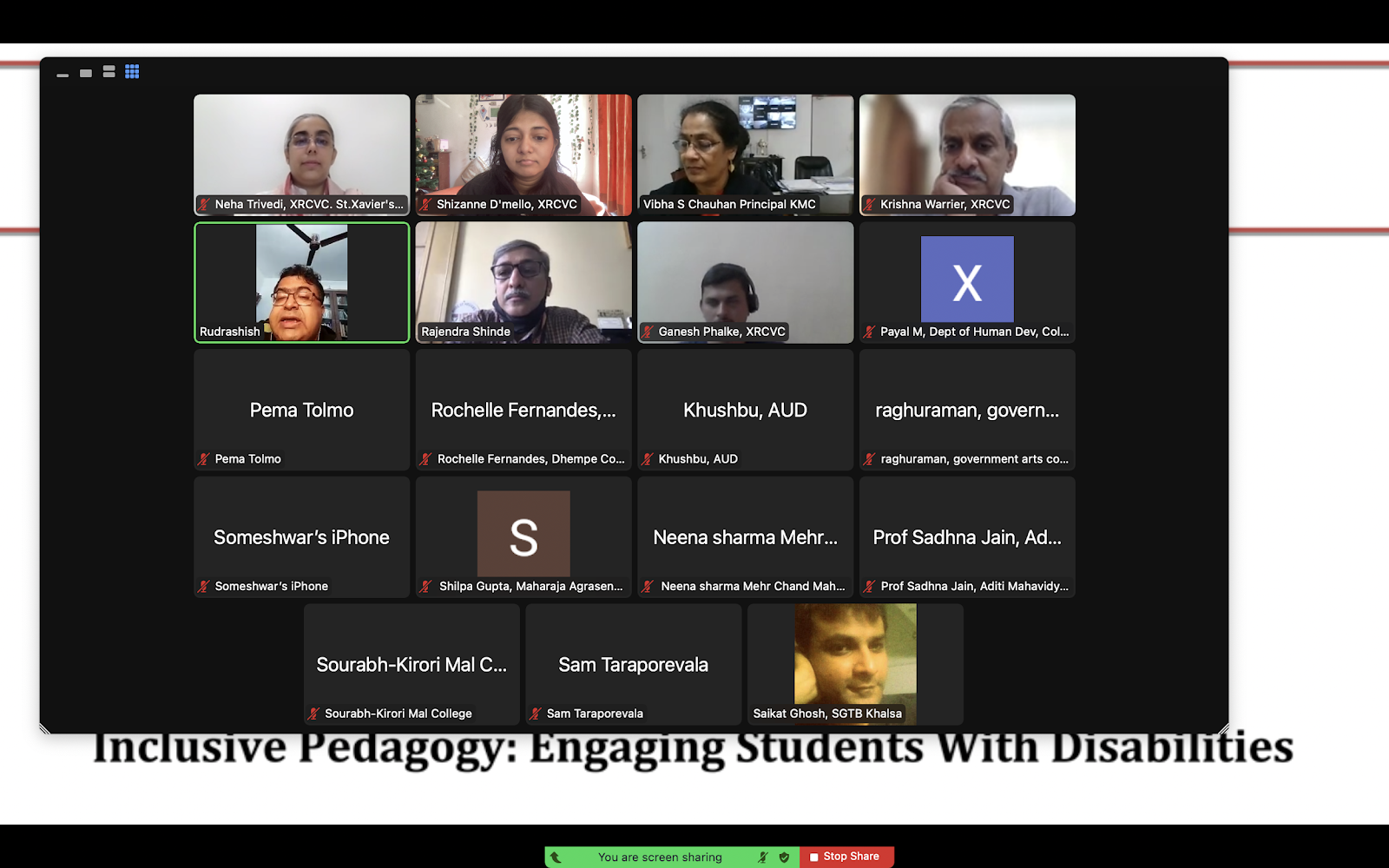
This webinar was inaugurated by Dr. Rajendra Shinde, Principal, St. Xavier’s College along with Dr. Vibha Singh Chauhan Principal, Kirori Mal College University of Delhi. Dr. Vibha expressed her concerns about educators lacking pedagogical knowledge to allow inclusion, despite them having the best intentions. She also shared how in her experience, colleges try to lower cut-offs to enable admission to students with disabilities. Dr. Rajendra Shinde shared contrary experiences at St. Xavier’s College. He also recognized key achievements through collaboration with the XRCVC, including the first student with total blindness pursuing B.Sc. (Chemistry) currently in his third year.
Day 1; 17 January 2022
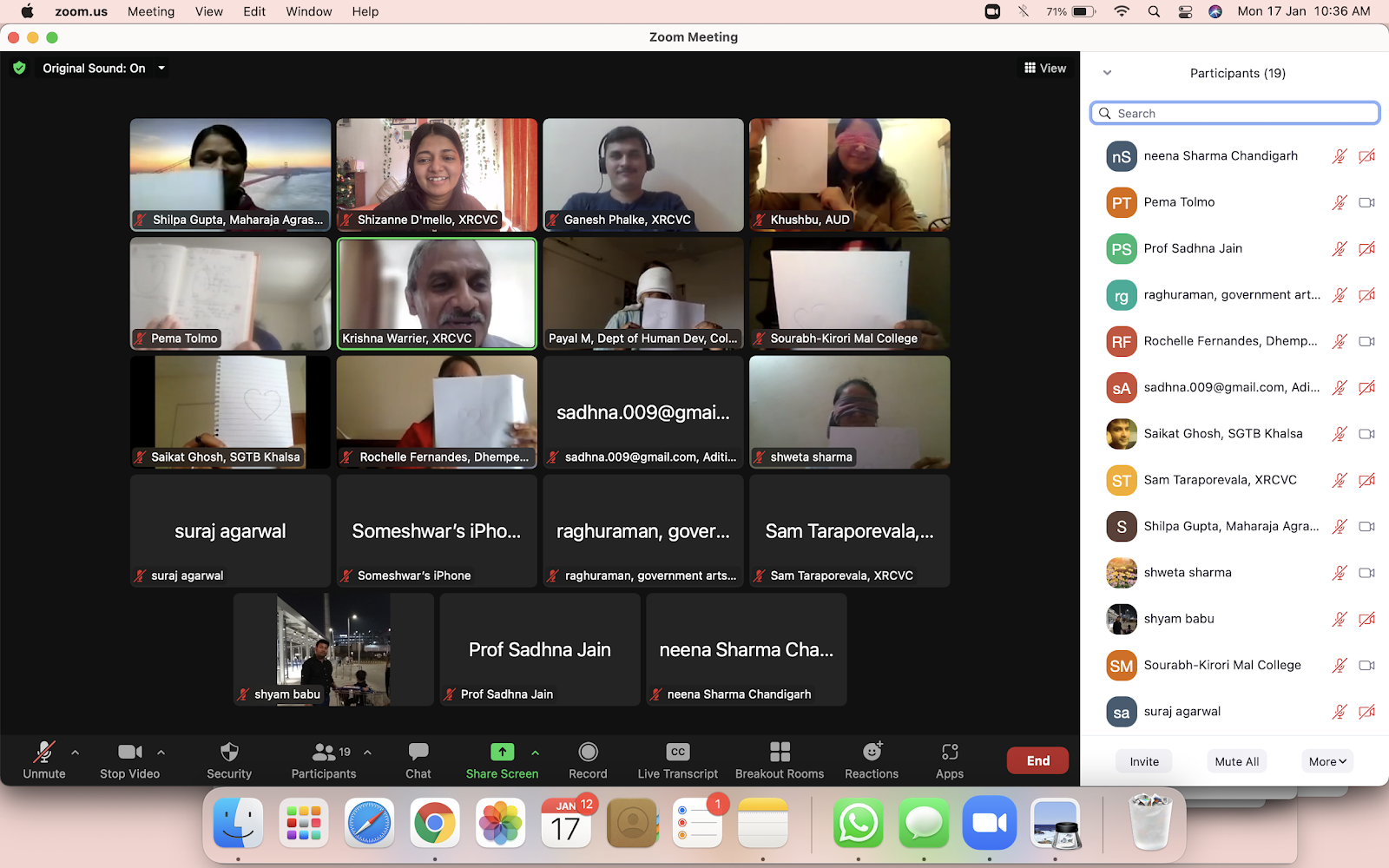
Day 1 began with an interactive sensitization session on the lives of persons with physical disabilities, where Mr. Krishna Warrier lead the participants through a range of activities to stimulate an experience of blindness and hearing impairment. The participants then demystified myths by speaking to Mr. Ganesh Phalke, an ex-student of St. Xavier’s College. Ganesh, along with three other participants with visual impairments shared their personal experience and preferences attending special and inclusive schools through an enriching dialogue, at the end of which, participants were introduced to the concepts of “sensory substitution” and “jugad” (makeshift).
This was followed by the second session for the day conducted by Ms. Neha Trivedi, aimed at understanding inclusive education and disability models, with the key takeaway being allowing students with disabilities to take on any field based on interest and aptitude, just like one would with any other student.
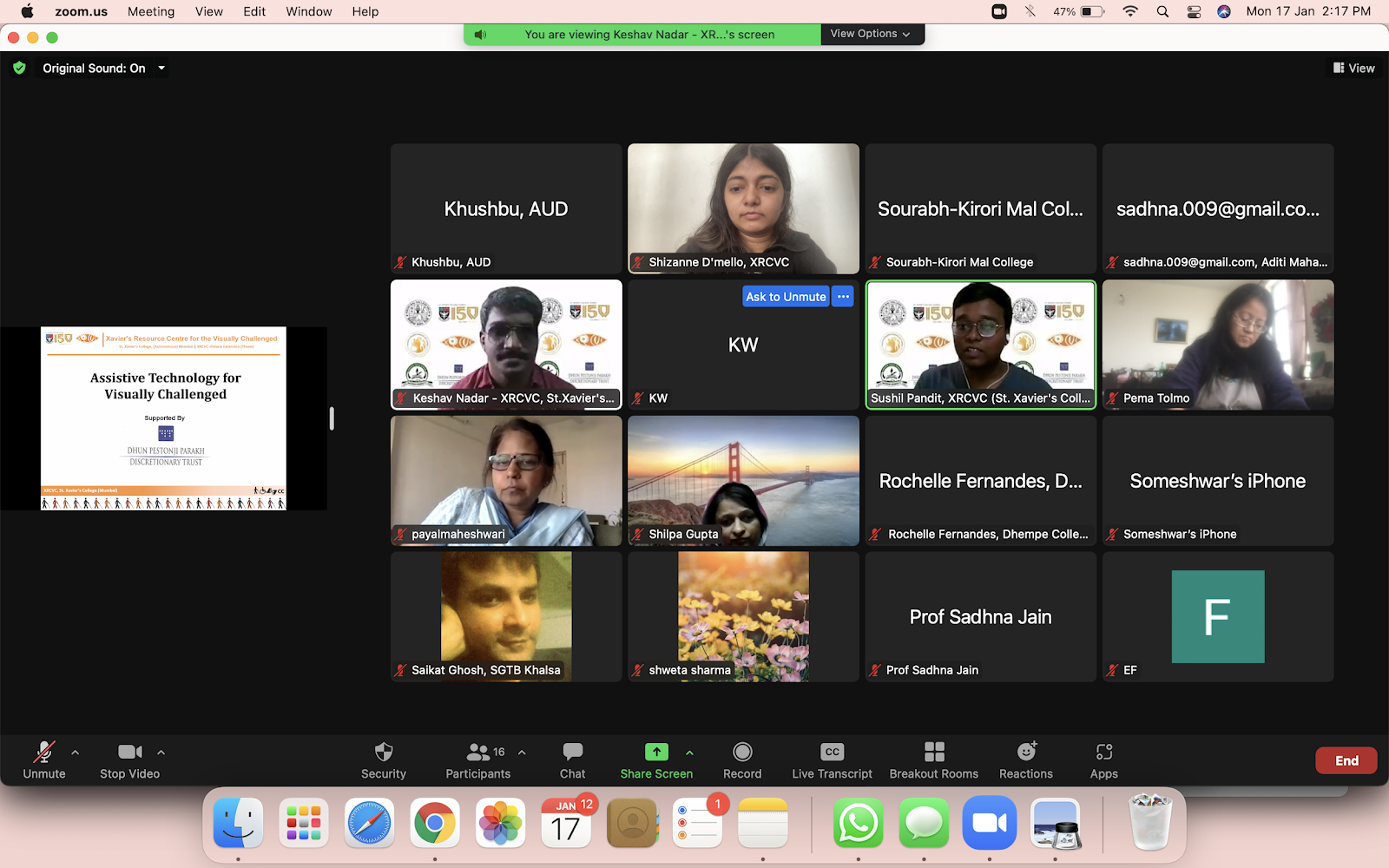
Session three, led by Mr. Keshavan Nadar and Ms. Sushil Pandit, introduced participants to an extensive range of assistive technologies for persons with visual impairment for reading, writing, mobility, and other daily chores.
The session on General Principles of Inclusive Education led by Ms. Neha Trivedi, allowed participants to reflect on their mindset around inclusive education to bring about a modification in their current teaching practices.
Day 2; 18 January 2022
Day 2, facilitated by Ms. Poonam Deokar and Ms. Shizanne D’mello, focused on a better understanding of a commonly misunderstood set of disorders – Specific Learning Disability (SLD), despite it being the largest category of students with disabilities.
Session one focused on stimulating problems in reading, writing, and mathematics to sensitize participants on the challenges and needs of students with an SLD. The following session introduced participants to assistive technologies that could support students with SLD perform tasks related to reading, writing, mathematics, memory, and organization. Knowledge check activities were conducted at various intervals. Additionally, session 3 had participants brainstorm on providing interventions to students with SLD through case studies and discussions.
Day 3; 19 January 2022
Day 3 aimed at understanding 2 more disability groups. For session 1, Ms. Akila Surendran, a Senior Engineer (Assistive Technology) at the Centre for Assistive Technology and Innovation (CATI) in the National Institute of Speech & Hearing (NISH), took participants through demystifying hearing impairment and focused on assistive technologies as interventions to aid the same.
For session 2, Dr. Sushama Nagarkar helped participants gain understanding about Autism Spectrum Disorder (ASD), and other key supportive strategies that used in the classroom, especially when working with students in higher education by sharing her experiences from being a parent of a child in the ASD spectrum and working with various institutes involved in the field.
Day 4; 20 January 2022
On Day 4, Ms. Neha Trivedi summarised all 21 types of disabilities under the RPWD Act, 2016. In the next session, she took participants through an India-tailored Inclusive Higher Education model that would be feasible without compromising on quality. The educators were also walked through setting up inclusive education services in their own institutes. This included volunteer services, assistive technology, training and remediation support in special skills. A session on inclusive examinations reiterated testing the student’s knowledge over proving competency in the method of the examination. Participants were given a list of teaching tips for various disability groups, before Mr. Keshavan Nadar and Mr. Sushil Pandit provided detailed training on how to make
online e-learning content accessible. This intended to improve navigation, readability, provide alt-text to images, handling tabular data, among other things. Participants were encouraged to try converting a document of their own using these tips through the session.
Day 5; 21 January 2022
The session on making online e-learning content accessible continued.
Session two was taken over by Parul Kumtha, a Universal Design architect, who summarised the purpose and means of creating an accessible campus, in line with the Harmonised Guidelines & Standards for Universal Accessibility in India, 2021. Being an advocate for autism and the mother of a young entrepreneur under the autism spectrum, she facilitated discussions around the need for creating spaces for inclusion in society. Finally, to wrap up all learnings for the day, participants worked on identifying and listing down interventions for case studies around co-morbid and multiple disabilities in a classroom.
Participants were asked to provide structured feedback for all days through forms that were sent out along with resources for the day.
Here is some feedback we received through the same:
“All the sessions were well designed and executed. if it is off-line, it would have been much more helpful to have a hands-on experience of the assistive devices and technology.”
Prof. K. Raghuraman, Assistant Professor, Government Arts College for Men (Autonomous) Nandanam, Chennai
“The modules are well planned and diverse, which gives a good perspective on developing inclusivity via different mediums.”
Khushbu Dublish, Assistant Professor, Ambedkar University, Delhi
“In my opinion modules are really comprehensive, clear, and informative, and require no change.”
Sourabh Kumar, Assistant Professor, Kirori Mal College, Delhi
“I feel today’s session were all good, a mix of activities and content sharing made it more comprehensive and also made sure we participate. In all informative sessions. I enjoyed.”
Payal Maheshwari, Associate Professor, College of Home Science, Nirmala Niketan, Mumbai
“It was a well-structured course. Looking forward to more such FDPs from you.”
Suraj Agarwal, Assistant Professor, Gargi College, New Delhi
We hope our FDP Programme enabled educators, who had minimal exposure to working with students with disabilities, to feel more equipped with the necessary understanding and mindset that will help them become drivers of inclusive education in their respective institutes and their classrooms.